People
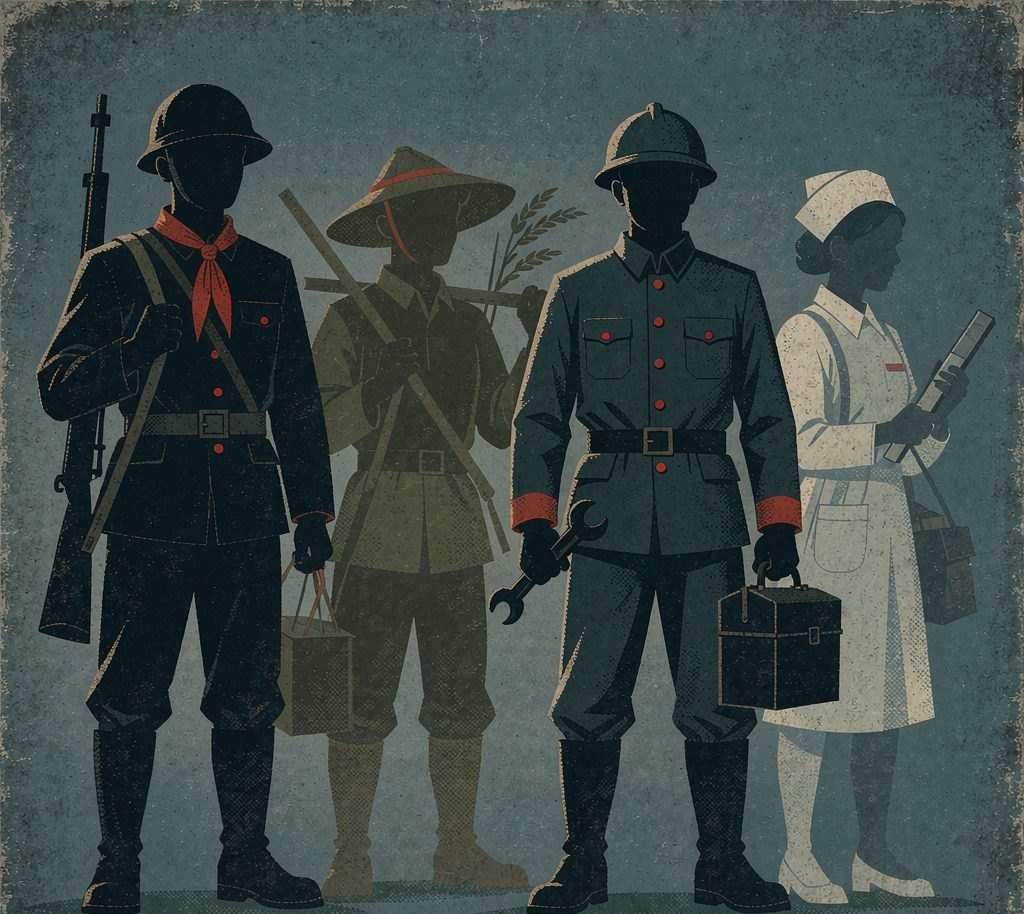
Overview of the People
The people in this edition are divided into five categories by how they appear in the documents: one author, three contemporaries, three moral examples, four opponents and others, three cited figures — fourteen in all. The classification follows the text itself — who is a signatory, who is the object described, who is cited as an authority or predecessor — not the editor's judgement of their historical standing.
The contemporaries group best reveals the nature of the documents: Peng Dehuai, Zhou Enlai and Zhu De appear in signatures, telegrams and narratives; Chiang Kai-shek, Yan Xishan and Du Yuming appear in the forms of address of declarations, telegrams and surrender demands. The two groups are placed together here because the base text writes them so, not because the editor intends a contrast.
The three in the moral-examples category come from different sources: Zhang Side and Norman Bethune are real contemporary persons, seen in 'Serve the People' and 'In Memory of Norman Bethune'; the Foolish Old Man comes from the Liezi 'Tang Wen' fable, cited as a parable in 'The Foolish Old Man Who Removed the Mountains'. Among the cited figures, Sima Qian, Sun Yat-sen and Lenin are invoked in the text as allusions or authorities.
Each person's depth is graded in three levels: S for deep reading, about two thousand words; A for medium reading, about one thousand; B for light reading, about six hundred. The grade follows the person's weight in this edition's documents, not their historical importance. Which documents each person's name appears in is listed in the roster.
People Index
14 people · in category order
| Name | Category | Lived | Depth | Appears in |
|---|---|---|---|---|
| Mao Zedong | Author | 1893—1976 | S | 02 03 04 05 07 09 10 12 13 14 16 17 18 19 23 25 |
| Peng Dehuai | Contemporaries | 1898—1974 | A | 16 20 21 22 24 |
| Zhou Enlai | Contemporaries | 1898—1976 | B | 13 16 20 22 |
| Zhu De | Contemporaries | 1886—1976 | B | 04 14 16 |
| Zhang Side | Moral Examples | 1915—1944 | A | 09 |
| Norman Bethune | Moral Examples | 1890—1939 | A | 08 |
| The Foolish Old Man | Moral Examples | Allegorical figure | B | 13 14 |
| Chiang Kai-shek | Opponents and Others | 1887—1975 | A | 03 04 05 07 12 13 14 16 |
| Yan Xishan | Opponents and Others | 1883—1960 | B | 04 05 |
| Du Yuming | Opponents and Others | 1904—1981 | B | 15 |
| Nikita Khrushchev | Opponents and Others | 1894—1971 | B | 17 18 |
| Sima Qian | Cited Figures | c. 145 BCE—c. 86 BCE | A | 09 |
| Sun Yat-sen | Cited Figures | 1866—1925 | A | 07 10 12 13 |
| Vladimir Lenin | Cited Figures | 1870—1924 | B | 02 07 08 12 13 14 |
Author
1 people
Contemporaries
3 people
Moral Examples
3 people
Opponents and Others
4 people
Cited Figures
3 people
Mao Zedong
Author · 1893—1976 · The author of this collection
Of the twenty-five pieces in this collection, the majority are signed by or delivered by Mao Zedong: from the December 1928 'Land Law of the Jinggang Mountains' to the April 1959 'Presidential Decree of the PRC', in genres of land law, Party resolution, declaration, telegram, speech, Ministry of National Defence message and presidential order. Three 1958 Ministry messages were issued in the minister's name but drafted by him; the final 1976 piece was issued after his death by the Party Centre and other institutions.
This force of ours exists wholly to free the people and works utterly for the people's benefit.
Today there are likewise two great mountains pressing down on the Chinese people: one is called imperialism, and the other is called feudalism.
Family and Origins
Born on 26 December 1893 in Shaoshan village, Xiangtan county, Hunan, into a peasant family. His father, Mao Shunsheng (registered name Yichang), farmed and also traded in grain; his mother was née Wen. There were two younger brothers. As a boy he attended the local private school, and did farm work in his spare time; his literacy and arithmetic came mainly from those few years. The intermingled self-cultivating and tenant farms around Shaoshan were the rural reality he met early; the land question treated in the collection's first piece, the 'Land Law of the Jinggang Mountains', connects directly to this experience. The law was enacted in December 1928, when he was thirty-five; the documents this edition collects begin with that year.
Youth and Study
In 1910 he entered Dongshan Higher Primary School in Xiangxiang, the next year went to Changsha and entered the Xiangxiang Provincial Middle School, where he came into contact with the publications of the Tongmenghui and the 1911 Revolution. In spring 1913 he was admitted to the Fourth Normal School of Hunan, which the next year merged into the First Normal, where he stayed five years until graduation in 1918. Under the influence of ethics teacher Yang Changji and Chinese teacher Yuan Zhongqian he read widely in history and philosophy, leaving many lecture notes and reading comments. Outside class he organised student groups and edited publications, practising writing and oratory. In autumn 1918 he went to Beijing as an assistant in the Peking University library, auditing philosophy and journalism courses, and returned to Hunan in March 1919. The collection's twelfth piece is the 1945 'Working Policy' report to the Seventh Congress, which contains a long first-person account: he says that in his early years 'I entered school and only knew a few bourgeois heroes, like Washington and Napoleon', and that 'I did not yet know there was a man called Marx'. This is the only first-hand material on his early experience in the collection.
Entering the Age
During the May Fourth Movement of 1919 he organised the student union in Changsha and edited the Xiangjiang Review, publishing 'The Great Union of the People'. In 1920 he took part in the communism study group and the Socialist Youth League activities in Changsha. In July 1921 he attended the First National Congress of the Communist Party of China. In 1923 he attended the Third Congress in Guangzhou and was elected to the Central Executive Committee. From 1924 he worked in the Shanghai and Guangzhou executive branches of the Kuomintang, serving as acting head of the KMT Central Propaganda Department and running the Political Weekly, while also investigating the Hunan peasant movement. The twelfth piece records the First Congress: 'it was originally held in Shanghai; because the concession police were about to arrest people, it moved to South Lake in Jiaxing, Zhejiang, and was held on a boat'; he also says that 'among the twelve representatives', by 1945 only three remained members of the Communist Party, and he was one of them. The same piece speaks of the 1924 First KMT Congress, that 'we attended the KMT congress as Communists', and that the congress's manifesto 'was drafted by us'.
Main Achievements
Of the twenty-three main-body pieces, twenty are signed by him or compiled from his reports and speeches; three 1958 Ministry messages were issued in the minister's name but drafted by him. In October 1927 he led a column to Jinggangshan; the next December he presided over the 'Land Law of the Jinggang Mountains', the collection's first piece, nine articles, confiscating all land and, after distribution, 'forbidding buying and selling'. In December 1929 the resolution of the Ninth Congress of the Fourth Red Army — the collection's second piece, 'On Correcting Mistaken Ideas in the Party' — says 'within the Communist Party of the Fourth Red Army there exist various non-proletarian ideas'. In December 1935 the Central Soviet Government issued the declaration to the Inner Mongolian people. In 1936 he led the Red Army's eastern expedition and issued several declarations and telegrams jointly with Zhu De. In September 1937 he wrote 'Combat Liberalism', opening with 'we stand for active ideological struggle'. On 12 October 1938 he delivered 'On the New Stage' to the Sixth Plenum, over fifty-four thousand characters; it sums up fifteen months of war and holds that 'the war of resistance is long, not short, so the strategic principle is protracted war, not quick decision'. On 21 December 1939 he wrote 'In Memory of Norman Bethune'; on 8 September 1944 he spoke at the memorial for Zhang Side, the speech being 'Serve the People'. On 24 April 1945 he delivered the written report 'On Coalition Government' to the Seventh Congress, whose centre is the one demand 'form a democratic interim coalition government'; around the same time he also gave the congress's opening address 'The Two Fates of China' and the working-policy report, and on 11 June delivered the closing speech 'The Foolish Old Man Who Removed the Mountains'. On 1 October 1949 he issued the Central People's Government proclamation, recorded as elected chairman of the Central People's Government and appointed chairman of the Revolutionary Military Commission of the People's Revolution. In October 1954 he wrote twice thanking the Soviet government delegation for donated machinery. In 1955, in the name of the PRC president, he issued an order ending the state of war with Germany. In October 1958 he drafted the three Ministry of National Defence messages, issued in the defence minister's name, the first opening with 'of the thirty-six stratagems, alliance is best'. On 14 April 1959 he signed the presidential decree promulgating the Tongdao Dong Autonomous County's organic regulations.
Posthumous Assessment
He died in Beijing on 9 September 1976. The collection's twenty-fifth piece is the joint announcement of 9 September 1976 by the Party Centre, the NPC Standing Committee, the State Council and the Central Military Commission, arranging the mourning from 11 to 17 September in the Great Hall of the People, the memorial meeting in Tiananmen Square at 1500 on 18 September, and the order that the whole nation 'half-mast flags in mourning' and stop all entertainment. This piece, like the appended twenty-fourth, 'The Ten-Thousand-Word Letter', is not his writing: the former is a funeral announcement for him, the latter a letter Peng Dehuai wrote to him. The collected documents run from December 1928 to September 1976, spanning forty-eight years. On his life's work, official documents and academic research each have their own account, greatly differing; this collection only reproduces the documents themselves and passes no judgement.
Life and Anecdotes
He read all his life; in his later years he still read histories and classical poetry and could recite large amounts by heart. He liked to use allusions and idioms to make a point: 'The Foolish Old Man' expands the Liezi 'Tang Wen' story; 'Serve the People' cites Sima Qian — both his usual method. The twelfth piece also cites the Zhuangzi, 'its beginning is simple, its end must be great', to describe the Party's growth. His speeches were mostly extempore, close to spoken language; the collected speech drafts preserve many questions and rhetorical counter-questions: 'The Foolish Old Man' has 'what mountain is there that we cannot dig away?'; 'Urging Du Yuming and Others to Surrender' is throughout in the second person, 'do you want to break out? On all sides are the Liberation Army — how can you break out?'. In the twelfth piece he also says in his own voice 'I say I had no sponsor', and 'we were then doing it ourselves, and did not know much, and can be said to have been young and ignorant and not to understand the world' — a rare first-person self-account in the collection.
Peng Dehuai
Contemporaries · 1898—1974 · Defence Minister; signatory of the three 1958 Messages to Taiwan Compatriots
A native of Xiangtan, Hunan, after leading the Pingjiang Uprising in 1928 he went to Jinggangshan; thereafter he served as commander of the Third Red Army Corps, deputy commander of the Eighth Route Army, and commander of the Chinese People's Volunteer Army. In this collection two kinds of document relate directly to him: the three 1958 Ministry messages issued in the name of 'Defence Minister Peng Dehuai'; and the appended 'Ten-Thousand-Word Letter', the letter he wrote to Mao in July 1959 during the Lushan Conference. The former were drafted by Mao, the latter is in his own hand; the two are less than a year apart.
Chen Yi, He Long, Li Lisan, Lin Boqu, Ye Jianying, He Xiangning, Lin Biao, Peng Dehuai, Liu Bocheng, Wu Yuzhang, Xu Xiangqian
I interjected several times in the Northwest small group; the opinions I did not finish setting out in the group meeting I now write to you for your reference.
Family and Origins
Born on 24 October 1898 in Wushi village, Xiangtan county, Hunan, into a poor peasant family. His mother died when he was young; he attended private school for two years, from age ten herded cattle, dug coal and made charcoal, and the family lived year to year on borrowed grain.
Youth and Study
In 1916 he joined the Hunan army as a soldier and rose to squad and platoon leader by bravery. In 1922 he entered the Hunan Military Officers' Training School; after graduation he returned to the Hunan army as company and battalion commander. In 1926 his unit was reorganised into the National Revolutionary Army and he joined the Northern Expedition, during which he came into contact with Communist ideas.
Entering the Age
In April 1928 he joined the Communist Party of China; in July he led the Pingjiang Uprising, formed the Fifth Red Army, and in December led his troops to Jinggangshan to join the Fourth Red Army. Thereafter he served as commander of the Third Red Army Corps and of the First Front Army, and took part in the counter-encirclement campaigns of the Central Soviet Area and the Long March. During the resistance he was deputy commander of the Eighth Route Army; in 1940 he directed the transport-disruption battle in North China. In 1947 he was commander of the Northwest Field Army; in 1949 commander of the First Field Army and its political commissar.
Main Achievements
In 1950 he was commander and political commissar of the Chinese People's Volunteer Army, directing the war to resist America and aid Korea. After returning in 1954 he was vice-premier of the State Council and defence minister; the collection's twentieth through twenty-second pieces, the three messages, were issued in the name of 'Defence Minister Peng Dehuai', drafted by Mao. In July 1959, during the Lushan Conference, he wrote a letter to Mao stating his views; the collection's appended twenty-fourth piece is that letter, signed 'Peng Dehuai' at the end. Thereafter he was relieved of his post and subjected to investigation for years.
Posthumous Assessment
He died on 29 November 1974. In 1978 the Party Centre restored his honour. In this collection his image has two sides: the defence minister who signed the Ministry messages, and the author of the appendix letter stating a differing view, the two a year apart. The rights and wrongs of the Lushan Conference were officially revised in the 1980s.
Life and Anecdotes
He lived plainly, acquired no private property, and wore cloth army uniforms year round. Strict with the army, he ate with officers and men, and was exacting toward subordinates. He wrote little; his telegrams and reports were mostly drafted himself, plain in wording and sparing of ornament.
Zhou Enlai
Contemporaries · 1898—1976 · Premier and Foreign Minister; the proposer of negotiations mentioned in messages
A native of Huai'an, Jiangsu, after returning to China in 1924 he was director of the Whampoa Academy's political department and for long handled the Party's united-front and foreign work. In this collection's sixteenth piece, the list of government personnel names him premier of the Government Administration Council and minister of foreign affairs; the twentieth and twenty-second messages of 1958 both mention that he had, a few years earlier, proposed to the Taiwan side holding peace talks. He is the author of no piece in this collection, appearing only by being named in lists and cited in messages.
Zhou Enlai is appointed Premier of the Government Administration Council of the Central People's Government and concurrently Minister of Foreign Affairs.
Premier Zhou Enlai proposed to you two years ago that talks be held to settle fairly the historical disputes between the KMT and the CCP and to liberate the Taiwan area by peaceful means.
Family and Origins
Born on 5 March 1898 in Huai'an, Jiangsu, into a declining official family; his father Zhou Shaogang, his adoptive father Zhou Yigan died early, and he was raised by his adoptive mother née Chen. He attended a family school in childhood; his training in literacy and composition began very early.
Youth and Study
After 1910 he studied in Fengtian and Tianjin; in 1913 he entered Nankai Middle School in Tianjin, and after graduating in 1917 went to Japan, auditing at schools in Tokyo. In 1919 he returned and entered Nankai University, joined the May Fourth Movement, edited the Tianjin Student Union Bulletin, and organised the Awakening Society.
Entering the Age
In 1920 he went to France for work-study; the next year in Paris joined a communism cell, and in 1922 organised the European Youth Communist Party of China. He returned to China in 1924 and became director of the Whampoa Academy's political department. In 1927 he took part in organising the Nanchang Uprising. In 1928 he went to Moscow for the Sixth Congress of the CCP, and after returning directed the Party's daily work in Shanghai.
Main Achievements
In 1931 he went to the Central Soviet Area, becoming a member of the Political Bureau and political commissar of the Red Army. In 1934 he joined the Long March; after the Zunyi Conference he joined the military command group. In 1936 he represented the CCP in the Xi'an Incident negotiations. During the resistance he directed the Party delegation and the Southern Bureau in Wuhan and Chongqing. In October 1949 he became premier of the Central People's Government's Government Administration Council and minister of foreign affairs, seen in the collection's sixteenth piece; from 1954 he was premier of the State Council. In 1955 he attended the Bandung Conference. In the two 1958 messages he is mentioned as having earlier proposed peace talks to the Taiwan side.
Posthumous Assessment
He died in Beijing on 8 January 1976. In this collection he appears only by being mentioned or listed, leaving no piece signed in his own name.
Life and Anecdotes
He worked extremely long hours, often reviewing documents late at night. Frugal in life and neat in dress, he kept detailed records in meetings with foreign guests and had the habit of personally checking the figures and transliterations in drafts.
Zhu De
Contemporaries · 1886—1976 · Red Army commander-in-chief; co-signatory of the 1936 declaration
A native of Yilong, Sichuan, he joined the Communist Party of China in Berlin in 1922 through Zhou Enlai's introduction, led the Xiangnan Uprising to Jinggangshan in 1928, and for long served as Red Army commander-in-chief. The collection's fourth piece, the declaration, was issued jointly by him and Mao Zedong, signed as chairman of the Revolutionary Military Commission of the Chinese Anti-Japanese Red Army; the fourteenth piece's note records his military report to the Seventh Congress; the sixteenth records his appointment as commander-in-chief of the People's Liberation Army. He is, after Mao and Peng, the military figure most often named in this collection.
Zhu De, Liu Shaoqi, Soong Ching-ling, Li Jishen, Zhang Lan and Gao Gang are appointed vice-chairmen.
Family and Origins
Born on 1 December 1886 in Yilong county, Sichuan, into a tenant-peasant family; many children in the family, he laboured with relatives in childhood, and his schooling depended on support from clan relatives.
Youth and Study
In 1909 he entered the Yunnan Military Academy, the same year joining the Tongmenghui. In 1911 he joined the Yunnan Uprising, later serving in the Yunnan army as regiment and brigade commander, taking part in the defences of the Protect-the-Republic and Protect-the-Constitution wars, becoming known in fighting around Naxi, Sichuan.
Entering the Age
In 1922 he went to Germany to study, joined the Communist Party of China in Berlin through Zhou Enlai's introduction, and in 1925 went to the Soviet Union to study military affairs. After returning in 1926 he did soldier-movement work in Sichuan and Jiangxi; in 1927 he joined the Nanchang Uprising as deputy commander of the Ninth Army.
Main Achievements
In January 1928 he led the Xiangnan Uprising; in April he led his troops to Jinggangshan to join Mao, becoming commander of the Fourth Worker-Peasant Revolutionary Army, and thereafter long served as Red Army commander-in-chief. In 1936 he was chairman of the Revolutionary Military Commission of the Chinese Anti-Japanese Red Army; the collection's fourth piece, the declaration, was issued jointly by him and Mao. During the resistance he was commander-in-chief of the Eighth Route Army. In 1945 he delivered the military report to the Seventh Congress, seen in the note to the collection's fourteenth piece. In 1949 he was appointed commander-in-chief of the People's Liberation Army, seen in the sixteenth piece.
Posthumous Assessment
He died in Beijing on 6 July 1976. This collection's records of him centre on three places: the joint declaration, the Seventh Congress military report, and the commander-in-chief appointment.
Life and Anecdotes
He lived plainly, in later years still grew vegetables and read history, and liked to visit old soldiers. He stood on no ceremony, often travelling without attendants, and was known in the army for his broad-mindedness.
Zhang Side
Moral Examples · 1915—1944 · Soldier of the Central Guard Regiment; subject of the 'Serve the People' speech
A native of Yilong, Sichuan, a soldier of the Central Guard Regiment of the Party Centre, he joined the Red Army in 1933, endured the Long March and was wounded, did guard duty after reaching northern Shaanxi, and in 1942, when the army was streamlined, switched to production and charcoal-making. On 5 September 1944, making charcoal in the hills of Ansai, Shaanxi, he died when the kiln collapsed; on 8 September the Guard Regiment held a memorial for him and Mao attended and spoke — the speech record is the collection's ninth piece, 'Serve the People'. He is the only ordinary soldier in this collection to leave his name because of a single elegy.
Comrade Zhang Side died for the good of the people, and his death is weightier than Mount Tai.
Family and Origins
Born in 1915 in a poor peasant family in Yilong county, Sichuan, with several younger siblings. His mother died early, his father left to make a living, and he was adopted by an uncle; in childhood he herded cattle and cut grass for a landlord and never attended school. Yilong is in northern Sichuan; another Yilong person in this collection is Zhu De, seen in the sixteenth piece's record of the PLA commander-in-chief appointment. On his family, the ninth piece records only his native place.
Youth and Study
He was barely literate; his reading and writing training came mainly from the literacy class and company cultural lessons after enlisting. In 1933 he joined the Red Army, the same year joined the Youth League, later transferring to membership of the Communist Party of China. The ninth piece's note one records: 'joined the Red Army in 1933, endured the Long March, was wounded, a loyal Communist serving the people' — this sentence is the main basis in the collection for his life; his childhood and schooling are not mentioned in body or notes.
Entering the Age
He took part in the Long March with the Fourth Front Red Army, and was wounded crossing the snow mountains and grassland, as the ninth piece's note one records. After reaching northern Shaanxi he did communications and guard duty in the army; around 1940 he was transferred into the Central Guard Regiment of the Party Centre, as squad leader and deputy squad leader, stationed around Ansai in northern Shaanxi; the note calls him 'a soldier of the Central Guard Regiment of the Party Centre'. The ninth piece opens: 'our Communist Party and the Eighth Route and New Fourth Armies it leads are a revolutionary team', and then places him within that team, calling him 'a comrade in this our team'.
Main Achievements
In 1942, when the army was streamlined, he obeyed the assignment and switched to production and charcoal-making. The ninth piece mentions the proposal 'better troops and simpler administration', noted in the annotations as a motion put by the non-party figure Li Dingming at the November 1941 session of the Shaanxi-Gansu-Ningxia Border Region's Second Consultative Council, of the same period. On 5 September 1944, digging a kiln to make charcoal in the hills of Ansai, he died when the kiln collapsed, aged twenty-nine; the note records 'on 5 September 1944, making charcoal in the hills of Ansai, northern Shaanxi, died when the kiln collapsed'. On 8 September the Central Guard Regiment held a memorial for him and Mao attended and spoke; the speech record is the ninth piece, marked at the end 'this is Mao Zedong's speech at the memorial meeting for Zhang Side held by the Central Guard Regiment of the Party Centre'. The piece also says 'we now lead a base area of ninety-one million people'; the note explains this is the total population of the Shaanxi-Gansu-Ningxia border region and the base areas of North, Central and South China.
Posthumous Assessment
The ninth piece places him within the argument that 'the meaning of death differs': first it says 'to die for the people's interests is heavier than Mount Tai', then immediately 'his death is heavier than Mount Tai'; the same paragraph also says 'to die for the fascists, to die for those who exploit and oppress the people, is lighter than a hair'. The same piece also proposes the method of memorial meetings: 'henceforth in our ranks, whoever dies, be he a cook or a soldier, so long as he has done some useful work, we shall bury him and hold a memorial meeting', and 'this shall become a system', and this method 'shall be introduced to the common people'. The note records only his native place, year of enlistment and circumstances of death; the body takes him as a concrete example, set alongside Sima Qian's saying on the weight of death.
Life and Anecdotes
The ninth piece, over twelve hundred characters, mentions him in only three places: the opening says he is a comrade in this our team, the middle says he died for the people's interests, the note records his native place and circumstances of death. His concrete deeds, beyond this collection, are mostly found in later reminiscences, which this collection does not cite. The piece also says 'our cadres must care for every soldier, and all in the revolutionary ranks must care for one another, love one another, help one another' — that sentence is the piece's demand on internal relations within the ranks.
Norman Bethune
Moral Examples · 1890—1939 · Canadian surgeon; the subject of 'In Memory of Norman Bethune'
A member of the Communist Party of Canada and a thoracic surgeon, in 1936, during the Spanish Civil War, he organised front-line blood-transfusion service. In early 1938 he led a medical team to China, reaching Yan'an at the end of March, and soon went to the Jin-Cha-Ji border region, working over a year in front-line hospitals, establishing field surgery and transfusion systems and training medical staff. He died of surgical infection on 12 November 1939 in Tang county, Hebei. The collection's eighth piece, 'In Memory of Norman Bethune', was written a little over a month after his death, as a memorial speech.
Comrade Bethune's spirit of utter selflessness in the service of others showed itself in his extreme sense of responsibility in his work and his extreme warmth towards his comrades and the people.
Family and Origins
Born on 3 March 1890 in Gravenhurst, Ontario, Canada, into a family of clergy; his grandfather and father both served in the church. In his youth he lived with his father in the northern forest region and came into contact with the lives of lumberjacks and miners. The eighth piece's note gives his full name as Henry Norman Bethune, with birth and death years as 1890 to 1939, and his identity as 'a member of the Communist Party of Canada'.
Youth and Study
He entered the University of Toronto medical school in 1912, and during the First World War served in the European theatre, later completing his medical training; he then practised in Detroit, New York and Montreal, specialising in thoracic surgery and serving as chief of thoracic surgery at the Royal Victoria Hospital in Montreal. The eighth piece records: 'Comrade Bethune was a doctor, who took medicine as his profession, and his technical skill was constantly improving', and that 'in the whole Eighth Route Army system his medical skill was very high' — two of the piece's appraisals.
Entering the Age
In 1935 he joined the Communist Party of Canada; in 1936, during the Spanish Civil War, he went to the front and organised a front-line blood-transfusion service — the mobile blood bank began there; the eighth piece's note records 'when the German and Italian fascists invaded Spain, he personally went to the front to serve the anti-fascist Spanish people'. After the outbreak of the war of resistance he came to China at the invitation of the Canadian and American Communist Parties and led a medical team, reaching Yan'an at the end of March 1938, and soon went to the Jin-Cha-Ji border region, working over a year in the border-region hospitals. The piece says he 'was already over fifty' and had come 'from afar, over ten thousand li, to help China's war of resistance'; the note says the team he led was the 'Canadian-American Medical Team'. The piece also says he 'arrived in Wutai Mountains' — matching the route the note describes.
Main Achievements
In the Jin-Cha-Ji border region he established field surgery and transfusion systems, trained medical staff in 1939 and 1940, compiled teaching materials suited to guerrilla-war conditions, and devised portable medical-instrument boxes so the team could stay as close to the front as possible, shortening the time from wounding to surgery. On 12 November 1939, at Tang county in Hebei, while giving first aid to the wounded, his finger was infected and his condition worsened; he died. The eighth piece's note says the cause of death was 'infection contracted while giving first aid to the wounded', and praises 'his spirit of sacrifice, his warmth of work and his sense of responsibility, all exemplary'.
Posthumous Assessment
The eighth piece was written on 21 December 1939, a little over a month after his death, entirely as a memorial. The piece classifies his conduct under proletarian internationalism, and cites, to the point of internationalism, Lenin's statement from 'Draft Theses on the National and Colonial Questions'; the note cites the source as Lenin's report of that title, giving volume and page. The piece says 'the people of the Jin-Cha-Ji border region who have themselves received the treatment of Dr Bethune and seen Dr Bethune's work with their own eyes cannot but be moved'. At the end there is also a passage about the author having met him only once and having received several letters from him; because he was busy, 'whether he received my replies, I do not know' — that is the author's account of their contact, and those letters are not collected here. He is the only foreigner in this collection.
Life and Anecdotes
He was stubborn in character and extremely strict about disinfection procedure, impressing the border-region hospital staff. Besides medicine he loved painting and often made sketches on the spot. The eighth piece says 'I saw Comrade Bethune only once'; later 'he wrote me many letters' but, busy, 'whether he received my replies I do not know' — that is the author's account of their contact, and those letters are not collected here.
The Foolish Old Man
Moral Examples · Allegorical figure · An allegorical figure from the Liezi 'Tang Wen'; a symbol in two speeches
A figure in the fable 'Tang Wen' of the Liezi, near ninety, because the Taihang and Wangwu mountains blocked his way he led his sons to dig the mountains, and the Wise Old Man mocked him; in the end the Heavenly God, moved, ordered the two strong gods to carry the mountains away. The collection's fourteenth piece, 'The Foolish Old Man Who Removed the Mountains', retells the story and compares imperialism and feudalism to the two mountains weighing on the Chinese people; the 1945 oral political report also tells the same story, praising the persistent will to remove the mountains. The use of the fable in the 1945 texts is rhetorical, not allegorical commentary.
The Foolish Old Man resolved to lead his sons to dig away these two great mountains with hoes.
Family and Origins
The Foolish Old Man is an allegorical figure in the Liezi 'Tang Wen'; north of Jizhou and south of the river, near ninety years old, with the Taihang and Wangwu mountains to the south blocking his way, he had to take a long detour.
The Story's Origin
Distressed that the north was blocked and detouring, he discussed with his family and proposed to level the two mountains blocking the way, so the road would lead straight to the south of Yuzhou and the Han river; the family agreed, only his wife raised a doubt: with your strength you cannot even move a small hill like that of your father-in-law's, so what can you do with the Taihang and Wangwu, and where will the earth and rock go? The others answered: throw them to the edge of the Bohai Sea.
The Debate with the Wise Old Man
So he led his sons to carry earth and rock in baskets to the edge of the Bohai Sea, returning only once in the cold and hot seasons. The Wise Old Man of Hequ laughed and tried to stop him, saying that with your remaining years and strength you cannot even destroy one hair of the mountains, so what can you do with the earth and rock? The Foolish Old Man sighed and answered: you are so stubborn you cannot be reasoned with, not even like the widow and her child; I have sons, and sons have sons, and grandsons without end, while the mountains will not grow, so why worry about not levelling them? The Wise Old Man had nothing to answer.
The Main Story
He kept digging. The snake god heard of it, fearing he would truly dig without stop, and reported to the Heavenly Emperor; the Emperor, moved by his sincerity, ordered the two strong gods to carry the two mountains away, one to the east of Shu, one to the north of Yong. From then on, south of Jizhou and north of the Han river were no longer blocked.
Posthumous Assessment
The collection's fourteenth piece compares the Communist Party and the forces it leads to the Heavenly Emperor moved by sincerity, and imperialism and feudalism to the two mountains weighing on the Chinese people, using 'digging every day' to show the persistence of the work. The fourteenth piece's retelling is closer to the original, the oral report's briefer; both are rhetorical uses of the fable.
Life and Anecdotes
The details in the Liezi original — the neighbour's orphan who came to help, the snake god reporting to the Emperor — are either reproduced or rephrased in the two speech retellings; the citations follow the original's selection: the fourteenth piece places the mountains in Shanxi, while the oral report follows the original in North China.
Chiang Kai-shek
Opponents and Others · 1887—1975 · Leader of the Nationalist government; the opposing side in several documents
A native of Fenghua, Zhejiang, principal of the Whampoa Academy in 1924, during the resistance he was chairman of the Military Affairs Commission; in December 1949 he went to Taiwan. In this collection he appears as a political object in several documents: the two 1936 declarations and telegrams accuse his troops of blocking the Red Army's eastward anti-Japanese advance, calling him 'the chieftain of the traitors' and also 'Chiang Kai-shek'; the 1945 report and speeches call him 'the Chairman'; the three 1958 messages call him 'your leader'. This collection only records these forms of address and passes no judgement.
Mr Chiang Kai-shek has in fact moved more than ten divisions into Shanxi, joining Mr Yan Xishan in blocking the Red Army's road to resistance against Japan.
Comrade Zhou Enlai said to Chiang Kai-shek: 'Mr Sun Yat-sen once said that a National Assembly would be convened in the future.'
Family and Study
Born on 31 October 1887 in Xikou, Fenghua, Zhejiang, into a salt-merchant and small-farmer family. His father Jiang Zhaocong died early; he was raised by his mother née Wang. He attended local private school, studying the Four Books and Five Classics. Later he went to Japan and entered the Tokyo Shinbu Gakko, where he met revolutionary students and, introduced by Chen Qimei, joined the revolutionary league.
Youth and Study
After 1912 he took part in anti-Yuan Shikai activities and associated with many revolutionary figures. In the 1920s he traded in Shanghai and ran a commodity and securities exchange. In 1923 he went to the Soviet Union to inspect the Red Army and the Party, and after returning was appointed by Sun Yat-sen to the Whampoa Academy.
Entering the Age
As the first Whampoa principal he thereby commanded a new-style armed force; after Sun's death and the split with the Communists he led the Northern Expedition and founded the Nanjing Nationalist government. After 1931 he presided over the Military Affairs Commission and, after the Xi'an Incident, shifted to resisting Japan; the collection's fourth and fifth pieces target his troops blocking the Red Army's eastward advance.
Main Achievements
After the December 1936 Xi'an Incident he stopped the encirclement campaign and turned to war against Japan. During the resistance he was chairman of the Military Affairs Commission and attended the Cairo Conference in 1943. After the 1945 victory he represented the Nationalist side in negotiations with the CCP, signed the Double Tenth Agreement, and soon the civil war resumed; in 1948 he became the first president under the 1947 constitution, and the next January stepped down, with Li Zongren acting as president. In December 1949 he went to Taiwan, where he continued as president, promoting land reform and local self-government.
Posthumous Assessment
He died in April 1975. This collection's documents treat him as a political object: the 1936 declarations and telegrams, the 1945 report and speeches, and the three 1958 Ministry messages all refer to him by different forms of address; the cross-strait document treatment of his assessment differs greatly, and this collection passes no judgement, only noting the forms of address in the text.
Life and Anecdotes
He kept a diary for decades without break; his wartime diary is now held at the Hoover Institution at Stanford and is common material for the study of modern Chinese history. He liked to read the collected works of Zeng Guofan and the writings of Wang Yangming.
Yan Xishan
Opponents and Others · 1883—1960 · Shanxi regional power; the named blocker of 1936
A native of Wutai, Shanxi, after 1911 he was elected military governor of Shanxi and ran its administration for nearly forty years, promoting village government, local schools and railways. When the People's Anti-Japanese Vanguard Army crossed the river into Shanxi, the collection's fourth and fifth pieces target his troops blocking the Red Army's anti-Japanese advance, with the phrase 'willing to be the running dog of Japanese imperialism' — that is the original's wording, which this collection does not alter on his behalf.
Among the troops of Chiang Kai-shek and Yan Xishan there are many patriotic soldiers willing to stop the civil war and resist Japan together.
Family and Origins
Born in 1883 in Helan village, Wutai, Shanxi, into a merchant and landowning family; his father Yan Yuntai ran a shop. He attended private school in childhood and at fourteen went with his father into business, familiar with accounts.
Youth and Study
In 1902 he entered the Shanxi Military Academy, and the same year went to Japan and entered the Tokyo Shimbu Gakko, joining the Tongmenghui there. After returning in 1909 he held a complete modern military education in the new Shanxi army.
Entering the Age
After 1911 he was elected military governor of Shanxi at age twenty-eight; thereafter he ran Shanxi's administration for decades, promoting village government, water conservancy and education as local construction, and on several occasions stood neutral in the central plains wars. After the 1930 defeat he took refuge in Dalian; in 1932 he became director of the Suiyuan-Shanxi political affairs office, reorganising Shanxi's administration and economy and building the Tongpu Railway.
Main Achievements
When the People's Anti-Japanese Vanguard Army crossed the river to campaign and occupied a section of the Tongpu Railway, intending to go to Hebei to fight Japan, the collection's fourth and fifth pieces target him: the former says his entire armed forces blocked the Red Army's anti-Japanese path; the latter says ' Chiang and Yan Xishan's troops' — many were willing to stop the civil war and unite against Japan. The same year the Red Army withdrew to the west bank of the Yellow River. During the resistance he was commander of the Second War Zone, defending Shanxi and fighting the Japanese and the CCP's armed forces.
Posthumous Assessment
After the fall of Taiyuan he went to Guangzhou as president of the Executive Yuan; at year's end he followed the Nationalist government to Taiwan, holding the vice-presidency and other posts; he died in 1960 and was buried at Yangming Mountain. Shanxi's wartime local archives are now partly preserved in Taiwan-side archives.
Life and Anecdotes
He governed meticulously, liked to use forms and charts to assess subordinates, and Shanxi's village government was based on household and land registers. Frugal in life, with simple food and no ostentation.
Du Yuming
Opponents and Others · 1904—1981 · Nationalist commander at Huaihai; addressee of the surrender demand
A native of Mizhi, Shaanxi, a first-class graduate of the Whampoa Academy, during the resistance he served as division and corps commander, deputy commander of the Chinese Expeditionary Force in Burma, and led troops into Burma. In 1948 he was deputy commander-in-chief of the Xuzhou Bandit Suppression Headquarters, commanding the Qiu Qingquan and Li Mi corps. During the Huaihai Campaign of November-December that year, the collection's fifteenth piece, 'Urging Du Yuming and Others to Surrender', was issued in the name of the headquarters of the Central Plains People's Liberation Army, opening by listing his military posts and urging him to order the whole army to lay down its weapons. He was captured in Anhui in January 1949.
To Generals Du Yuming, Qiu Qingquan and Li Mi, and the corps, division and regimental commanders of the Qiu and Li army groups
Family and Origins
Born on 28 November 1904 in Mizhi, Shaanxi, into a scholarly family; his father Du Liangkui was a late-Qing xiucai, and the family had a fair number of books; he studied at home in childhood.
Youth and Study
He studied locally in his youth; in 1924 he was admitted to the first class of the Whampoa Academy, the same year joining the Kuomintang; after graduation he served as platoon leader in the National Revolutionary Army, taking part in the Northern Expedition and rising to company commander.
Entering the Age
After 1937 he was commander of an armoured regiment and the 200th Division, a commanding officer of the early mechanised units of the Nationalist army. In 1939 he led troops in the Kunlun Pass battle. In 1942 he was deputy commander-in-chief of the Chinese Expeditionary Force in the first Burma campaign, leading troops into Burma; in the retreat the unit suffered heavy losses and part withdrew into India.
Main Achievements
After the victory of the resistance he was commander of the Northeast Security Headquarters; in 1948 he was deputy commander-in-chief of the Xuzhou Bandit Suppression Headquarters, commanding the Qiu Qingquan and Li Mi corps. In November-December that year the collection's fifteenth piece, issued in the name of the headquarters of the Central Plains People's Liberation Army, opens by listing his military posts, explains the ends of the Huang Wei, Li Yannian and Sun Yuanliang corps, and urges him to order the whole army to lay down its weapons. In January 1949 he was captured in Xiaoxian, Anhui.
Posthumous Assessment
After capture he underwent reform in a war-criminals management centre; in December 1959 he was granted a special pardon, later serving as a specialist in the Historical Materials Committee of the National Committee of the CPPCC, writing reminiscences of the Liaoshen and Huaihai campaigns, which became commonly used material for researchers. He died in Beijing on 7 May 1981.
Life and Anecdotes
Strict and orderly in command, he valued his troops' equipment and logistics, and paid special attention to the maintenance and fuel supply of mechanised units. In later writing he had the habit of first listing a timetable, then recalling day by day.
Nikita Khrushchev
Opponents and Others · 1894—1971 · Soviet leader; addressee of the two 1954 thank-you letters
After Stalin's death in 1953 he became First Secretary of the CPSU Central Committee. In October 1954 he led a Soviet government delegation to China for the PRC's fifth anniversary; the collection's seventeenth and eighteenth pieces are the two thank-you letters Mao wrote for this, addressed to 'Comrade Khrushchev and the Soviet government delegation' — one thanking for the exhibition's machine tools and agricultural machines, one for the state grain farm's equipment. In 1956 he delivered a report against the personality cult at the 20th Congress.
Dear Comrade Khrushchev and the Government Delegation of the Soviet Union: the delegation's letter of 5 October 1954 has been duly received.
On the fifth anniversary of the founding of the People's Republic of China, the Soviet Government Delegation, on behalf of the Soviet people, presented to the Chinese people
Family and Origins
Born on 17 April 1894 in the village of Kalinovka, Kursk province, Russia, into a peasant family. In his youth he herded cattle, and from age fourteen worked as a fitter in the Donbas mining region.
Youth and Study
He had little schooling; his literacy and technical training came mainly from the factory and workers' night school. In 1918 he joined the Russian Communist Party (Bolsheviks), took part in the civil war, and after the war did Party and economic work in the Donbas. In 1929 he was sent to the Moscow Industrial Academy, where he served as the academy's Party secretary, thereby entering the upper levels of the Party.
Entering the Age
In the 1930s he served as Party secretary of the Moscow city and oblast committees, directing metro and other construction. In 1938 he became First Secretary of the Ukrainian Party Central Committee. During the Patriotic War he was a member of the military councils of several fronts, taking part in the fighting around Stalingrad. In 1949 he returned to Moscow to head agriculture.
Main Achievements
After Stalin's death in 1953 he became First Secretary of the CPSU Central Committee. In October 1954 he led a Soviet government delegation to China; the collection's seventeenth and eighteenth pieces are the two thank-you letters Mao wrote for this. In 1956 he delivered a report against the personality cult at the 20th Congress. In October 1964 he was relieved of his post.
Posthumous Assessment
He died in Moscow on 11 September 1971. This collection mentions him only in the thank-you letters; the wording is diplomatic gratitude on a formal occasion, with no other content.
Life and Anecdotes
Blunt in speech, he liked to interject impromptu at public occasions, and was especially keen on agriculture and corn cultivation, repeatedly explaining planting methods on collective farms in person.
Sima Qian
Cited Figures · c. 145 BCE—c. 86 BCE · Western Han historian; cited in 'Serve the People' for his letter to Ren Shaoqing
A native of Xiaoyang in the Western Han (present-day Hancheng, Shaanxi), he succeeded his father Sima Tan as Grand Astrologer, and because of the Li Ling affair suffered castration, enduring the shame to complete the Records of the Grand Historian in 130 chapters, China's first biographical general history. The collection's ninth piece, 'Serve the People', cites the saying 'a man dies either heavier than Mount Tai or lighter than a feather' to show that deaths differ in weight; the note explains the saying is found in the 'Biography of Sima Qian' in the Book of Han, recording the 'Letter to Ren Shaoqing', originally 'death may be heavier than Mount Tai, or lighter than a feather'. This is the only ancient quotation in the collection.
In ancient China a writer named Sima Qian said: 'Death befalls every man alike; it may be weightier than Mount Tai, or lighter than a goose feather.'
Family and Origins
Born around 145 BCE in Xiaoyang (present-day Hancheng, Shaanxi). His ancestors had held the offices of astronomy and record-keeping since the time of Zhuanxu; his father Sima Tan served as Grand Astrologer under Emperor Wu of Han, in charge of records and astronomy, and on his deathbed entrusted the work of history to him. The ninth piece calls him 'a man of letters in ancient China', while the note calls him 'a famous man of letters and historian of the Western Han'; both appear in that piece.
Youth and Study
In his youth he farmed and herded in the countryside; at ten he went with his father to Chang'an, studying the classical scriptures, taught by Dong Zhongshu and Kong Anguo, reading the Spring and Autumn Annals and the Documents. From age twenty he travelled the whole country, south to Kuaiji and the Yuan-Xiang, north to Qi-Lu and Zou-Yi, inspecting relics and traditions, accumulating material for his later work. These two periods are mainly inferred by later generations from the self-accounts in the various chapters of the Records and the fragments in the 'Letter to Ren Shaoqing'; the ninth piece does not touch his youth, only citing his one saying on death.
Suffering and Writing
In the third year of Yuanfeng (108 BCE) he succeeded his father as Grand Astrologer and began sorting the imperial library and archives. In the second year of Tianhan (99 BCE), for defending Li Ling he angered Emperor Wu and was sentenced to castration; the family, poor, could not ransom him, so he endured it. After release he served as palace secretary and in his remaining years devoted himself to writing. In the 'Letter to Ren Shaoqing' he describes his situation after the punishment and lists the ancients who, meeting adversity, wrote books to console themselves, explaining that he lived on in shame to finish this not-yet-completed work. The ninth piece cites exactly the letter's line on death; the note explains the quotation is found in the 'Biography of Sima Qian' in the Book of Han, which records the 'Letter to Ren Shaoqing'.
The Compilation of the Records
The whole work has 130 chapters, in the five categories of basic annals, tables, treatises, hereditary houses and biographies, recounting from the Yellow Emperor to Emperor Wu of Han, China's first biographical general history. The ninth piece's note records 'wrote the Records of the Grand Historian in 130 chapters', matching this. The original manuscript was kept in the family and only circulated after his grandson Yang Yun. The 'Biography of Sima Qian' in the Book of Han includes his 'Letter to Ren Shaoqing', self-accounting his life and his intention to write, the source of the cited line. The note also points out that the body's 'heavier than Mount Tai' reads in the Book of Han original as 'death may be heavier than Mount Tai, or lighter than a feather', a slight difference in wording.
Posthumous Assessment
The ninth piece cites his saying on death to lead into the later argument on the weight of death: first it says 'a man of letters in ancient China named Sima Qian once said', then quotes 'a man dies either heavier than Mount Tai or lighter than a feather', then continues 'to die for the people's interests is heavier than Mount Tai; to die for the fascists, to die for those who exploit and oppress the people, is lighter than a feather'. The note gives the source and the textual variant. For this collection he is the only ancient author cited; all its account of him is this one quoted line and one note.
Life and Anecdotes
The 'Letter to Ren Shaoqing' lists ancients who met punishment and disgrace to console themselves, its tone urgent and impassioned, the main material for later generations to understand his life. His year of death has no certain proof, generally inferred around 86 BCE. This collection, in citing him, does not mention his punishment and writing, taking only his one line; the note only gives the source and variant, not his life.
Sun Yat-sen
Cited Figures · 1866—1925 · Founder of the Kuomintang; cited in several reports for his Three Principles
A native of Xiangshan, Guangdong, in 1894 he founded the Revive China Society, and in 1905 in Tokyo formed the Tongmenghui, proposing the three principles of nationalism, democracy and people's livelihood; in 1912 he was provisional president of the Republic of China. The collection's seventh piece, 'On the New Stage', and tenth piece, 'On Coalition Government', cite his Three Principles as a rallying call, and record the 1924 KMT reorganisation and the three policies of alliance with Russia, co-operation with the Communists and assistance to peasants and workers; the twelfth and thirteenth pieces also speak of his person and work, and comment on the difference between his principles and the New Democracy. The documents' uses are reproduced without elaboration.
In 1924 Mr Sun Yat-sen accepted the proposal of the Chinese Communist Party and convened the First National Congress of the Kuomintang, with Communists taking part.
Family and Origins
Born on 12 November 1866 in Cuiheng village, Xiangshan county, Guangdong, into a poor peasant family. His father Sun Dacheng farmed and also worked as a shoemaker; his elder brother Sun Mei went to Honolulu to work, later running a ranch and shop, improving the family's circumstances.
Youth and Study
In 1879 he went with his mother to Honolulu, attended a local missionary school, studying English and Western learning, and came into contact with Christianity and Western political knowledge. In 1883 he returned and later attended schools in Hong Kong. In 1886 he entered the medical school attached to the Guangzhou Boji Hospital, the next year transferred to the Hong Kong College of Medicine, graduated in 1892, and thereafter practised in Macao and Guangzhou.
Entering the Age
In 1894 he submitted a reform proposal to Li Hongzhang, receiving no reply; that winter he founded the Revive China Society in Honolulu. In 1895 he plotted the Guangzhou Uprising, failed, and went into exile overseas, contacting overseas Chinese and students in Europe, America and Japan. In 1905 in Tokyo he united various groups into the Chinese Revolutionary Alliance (Tongmenghui), was elected its director-general, and proposed the three principles of nationalism, democracy and people's livelihood. Thereafter he launched several uprisings in the South China border and the middle and lower Yangtze.
Main Achievements
After the 1911 Wuchang Uprising he returned to China; on 1 January 1912 he became provisional president of the Republic of China, promulgated the provisional constitution, and in March yielded the presidency to Yuan Shikai. Thereafter he launched the Second Revolution and the Constitutional Protection Movement, rising and falling repeatedly. In January 1924 he convened the First National Congress of the Kuomintang in Guangzhou, reorganised the KMT, and set the three policies of alliance with Russia, co-operation with the Communists and assistance to peasants and workers — recorded in the collection's tenth piece; the same year he founded the Whampoa Academy and in November went north to discuss state affairs.
Posthumous Assessment
He died in Beijing on 12 March 1925. The collection's seventh, tenth, twelfth and thirteenth pieces all mention him: the first three cite his Three Principles as a rallying call, the twelfth says the formulation that politics is 'the affairs of the many' comes from his speech, and the thirteenth comments on his work and its limits. These are all uses within the documents.
Life and Anecdotes
He read enormously, almost to the point of a collecting habit, often carrying maps and engineering books in his luggage. He did not smoke, ate plainly, and left no private property at his death.
Vladimir Lenin
Cited Figures · 1870—1924 · Russian revolutionary theorist; cited as theoretical basis
A native of Simbirsk, Russia, in 1917 he led the October Revolution and became chairman of the Council of People's Commissars; in 1919 he founded the Comintern and wrote 'Draft Theses on the National and Colonial Questions'. The collection's eighth piece, 'In Memory of Norman Bethune', cites a passage 'Leninism holds that' to show the claim that the proletariat of capitalist countries and the peoples of the colonies and semi-colonies support each other, with Bethune as an example of practising this line; the note cites the above theses as its basis. The seventh, twelfth and thirteenth pieces also frequently mention him alongside Marx, Engels and Stalin.
Leninism holds that the proletariat of the capitalist countries must support the liberation struggles of the peoples of the colonies and semi-colonies.
Family and Origins
Born on 22 April 1870 in Simbirsk (now Ulyanovsk), Russia. His father was an inspector of the provincial education board; his mother was the daughter of a physician; the family of six children valued reading and education.
Youth and Study
In 1887 he entered the law faculty of Kazan University but was expelled for student activism, and later passed the examinations of the St Petersburg University law faculty as an external student, qualifying as a lawyer. In 1893 he went to St Petersburg, doing propaganda and organisation work among workers' study circles while studying Russian economic statistics.
Entering the Age
In 1895 he organised the St Petersburg League of Struggle for the Emancipation of the Working Class, was arrested and exiled to Siberia for three years. In 1900 he went abroad, ran the Spark newspaper in Munich and elsewhere, preparing for the founding of the Party. In 1903, at the Second Congress of the Russian Social Democratic Labour Party, the Bolshevik faction formed. In April 1917 he returned to Russia, proposed the April Theses, and in November led the October Revolution.
Main Achievements
After the revolution he chaired the Council of People's Commissars; from 1918 to 1920 he directed the economic and military policy of the civil-war period, and in 1921 turned to the New Economic Policy. In 1919 he founded the Comintern and wrote 'Draft Theses on the National and Colonial Questions'; the eighth piece's note cites this work and the 'Report of the Commission on the National and Colonial Questions' as the basis of the internationalist line the piece describes. After 1922 he ceased daily work because of illness.
Posthumous Assessment
He died on 21 January 1924. In this collection he appears as a cited theorist: the eighth piece cites 'Leninism' to explain the internationalist claim, while the other pieces mostly mention him alongside Marx, Engels and Stalin as an object of Party members' study.
Life and Anecdotes
He wrote very diligently, reading and excerpting at high speed, with the habit of writing short marginal notes. Plain in life, strict about time, he often started meetings on time, and the late had to explain why.