Themes
Overview of the Six Themes
This edition collects twenty-three pieces by the author himself, plus two appended documents, from the 'Land Law of the Jinggang Mountains' of December 1928 to the four-institution communique of September 1976, forty-eight years in all. The six themes below are not categories imposed by the editor; they are six ways of reading taken from the documents' own concerns. One document often belongs to several themes — for example 'On Coalition Government' speaks of land, but also of the united front and of state-building institutions.
Read by era, you see how the propositions changed with the situation; read by theme, you see how the same issue was formulated in different eras. The two ways complement each other: reading lengthwise you see change; reading across you see constancy. The 'Land Law of the Jinggang Mountains' and the 1954 letter thanking the Soviet government delegation are twenty-six years apart; what they care about is no longer the same kind of thing, but the question 'rely on whom, unite with whom' appears in both eras.
The six themes are not evenly weighted: 'State-Building, Institutions and Diplomacy' involves seven pieces, the most; 'Land and the Peasantry', 'Serving the People and Moral Examples' have three each, the least. This is the distribution of the documents the base text actually holds, not a choice of the editor — this edition collects only what Wikisource has recorded, adds nothing unrecorded, and does not supplement from other editions.
Under each theme we first give the background, then cite the original, then add an explanation. The citations are always verbatim from the base text — not rewritten, not abridged; the explanation only dates the documents and explains wording, offering no evaluation. The full text of all six themes is gathered on this page, to be read from first to last; if you want to read a single theme, each also has its own page.
Land and the Peasantry
3 works · Read the theme page →
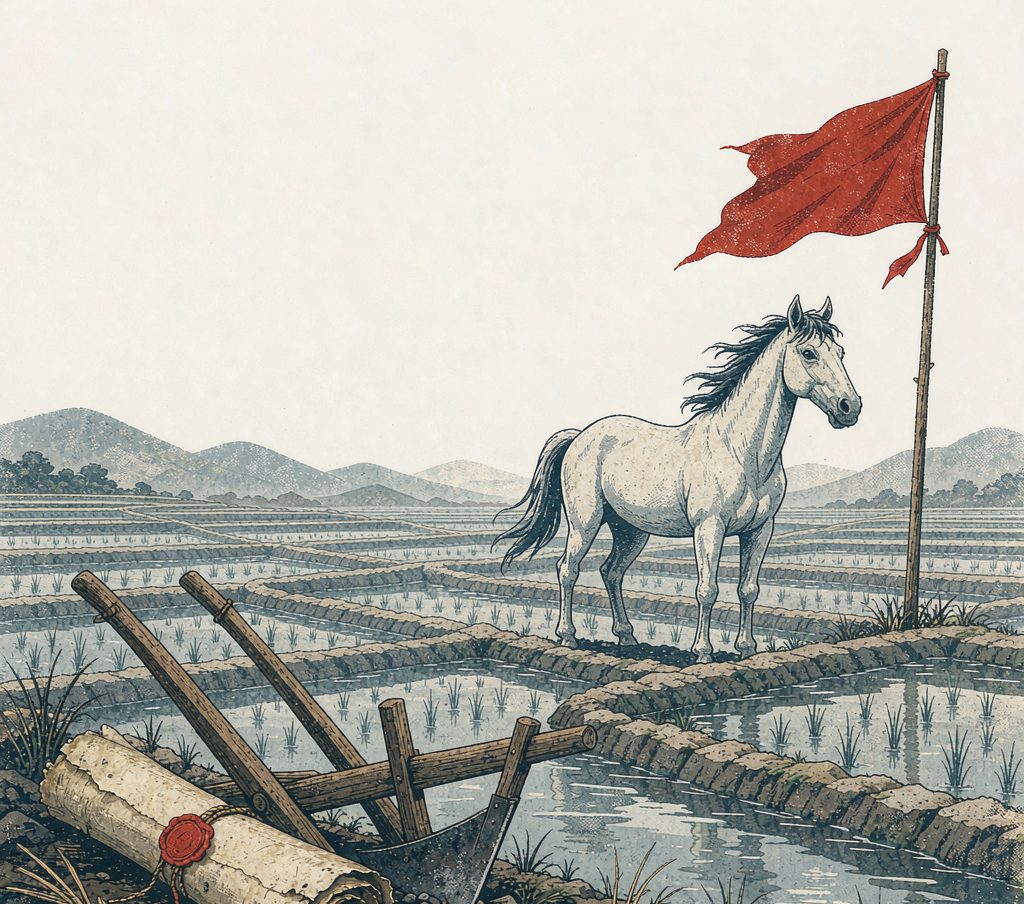
This theme gathers three documents spanning 17 December 1928 to 24 April 1945. Their genres differ and so do their ways of handling land. The December 1928 'Land Law of the Jinggang Mountains' is a statute, setting out confiscation and distribution article by article. The December 1935 'Declaration of the Central Soviet Government to the People of Inner Mongolia' is an external declaration, telling the Mongolian people the Soviet government's attitude to land, pastures and salt ponds. The April 1945 'On Coalition Government' is a congress report whose sixth item, 'The Land Question', places land reform among the concrete programme of the time.
The 'Land Law of the Jinggang Mountains' has nine articles. The first confiscates all land for the Soviet government and distributes it by three methods — to peasants for individual cultivation, to peasants for collective cultivation, and organised by the Soviet government as model farms, with the first as the main method. The second forbids buying and selling once all land is confiscated and distributed by the Soviet government. The fourth sets two standards for the quantity distributed: one by population, sharing equally among old and young, male and female; one by labour power, giving those who can labour twice what those who cannot receive. It gives three reasons for adopting the first standard, including that before the facilities for supporting the aged and rearing the young are complete, the old and young, if given too little land, cannot subsist.
This land law also treats mountain forests, the land tax and handicraft workers. Mountain forests are divided into tea hills, fuel hills and bamboo-wood hills; the first two are distributed for average use by township, the bamboo-wood hills belong to the Soviet government and peasants may enjoy the bamboo and wood with its permission. The land tax is set at 15%, 10% or 5% according to production; in natural disaster or other special circumstance one may petition the higher Soviet government for exemption. Landless village handicraft workers who voluntarily take fields receive half the amount a peasant receives; Red Army and local-militia officers and men, and those serving in the government and other public bodies, are all allotted land, farmed for them by Soviet-hired substitutes.
The December 1935 'Declaration of the Central Soviet Government to the People of Inner Mongolia', signed by Mao Zedong as chairman of the Central Soviet Government of the Chinese Soviet Republic, first states the situation of the Inner Mongolian nation, saying Japanese imperialism must occupy all China and therefore first Manchuria and Mongolia, and that the Chinese warlords led by Chiang Kai-shek have made the whole region of Inner Mongolia into provinces and repeatedly sent petty warlords to seize the Mongolian people's pastures and salt ponds. The declaration then lists five points; the first holds that the original six leagues, twenty-four banners, forty-nine banners of Inner Mongolia, the two banners of Chahar Tumet and the three special banners of Ningxia — whether already turned into counties or still grassland — shall all be returned to the Inner Mongolian people as their territory.
The declaration's fourth point is more concrete: first return the pastures and two salt ponds seized by Jing Yuexiu, and the region seized by Gao Shixiu, to the Inner Mongolian people, and make the places near the Long Wall — Ningtiaoliang, Anbian, Dingbian — into commercial zones to develop trade between the two sides. The fifth point says the Workers' and Peasants' Red Army guerrillas or other armed forces have absolutely no intention of advancing across the grassland, and expresses willingness to conclude a mutual-defence alliance. Compared with the 1928 land law, the land spoken of here is no longer fields distributed to peasants for cultivation, but the ownership of pastures, salt ponds and territory.
The April 1945 'On Coalition Government', in the sixth item of its concrete programme, takes up the land question. It says that, to destroy Japanese invaders and build a new China, land reform must be carried out and the peasants liberated, and cites Dr Sun Yat-sen's slogan 'land to the tiller' as the correct slogan of the bourgeois-democratic revolutionary stage of the time. It then explains that 'land to the tiller' transfers land from feudal exploiters to the peasants, making it the peasants' private property, freeing the peasants from the feudal land relation and raising agriculture from its old backward level to a modern one.
The same report also writes of the war-time practice: during the resistance, all is subordinated to resistance, and rent reduction and interest reduction and all democratic reforms are for resistance, not isolated from it; to unite all social strata against the common enemy, the landlords' land ownership is not abolished and rent and interest are paid appropriately. It also says that once the land system is reformed, even if only initially — as after rent reduction — the peasants' production interest increases, and then, helping the peasants to organise voluntarily into agricultural producers' cooperatives, productivity develops.
Read together, the three pieces show a shift in wording: the 1928 law writes of confiscation and distribution; the 1935 declaration writes of the return of pastures and territory; the 1945 report writes of reform alongside rent reduction. The same word 'land' refers to different objects and is handled differently in the three documents; their objects expand from the base-area peasants, to the Inner Mongolian people, to the whole nation the report addresses.
Editor's note: this page is read across by theme; all excerpts are taken verbatim from the base text, punctuation included. Each piece's date follows the base text and common cataloguing. The several pieces' statements on land must be read back into their own year and object; this page only states what each piece writes, offers no evaluation, and draws no analogy to other periods.
Excerpts
Works Cited
The United Front and Resistance
5 works · Read the theme page →
This theme gathers five pieces written between December 1935 and 24 April 1945. The first three are declarations and telegrams addressed to the military and political organs of the whole country, the parties and groups, and compatriots who will not be slaves; the last two are congress reports. All five speak of union: whom to unite with, what to unite for, in what form, and what government to form after uniting.
The December 1935 'Declaration of the Central Soviet Government to the People of Inner Mongolia' makes the object of union concrete: only by struggling together with the Inner Mongolian nation can we quickly defeat our common enemy, Japanese imperialism and Chiang Kai-shek; and the Inner Mongolian nation may organise itself as it wishes, has the right to organise its life on the principle of autonomy, to form a federal relation with other nations, or to separate completely. The declaration's end says that whoever has the resolve against Japanese imperialism and Chiang Kai-shek and the other Chinese warlords, whether led by princes and nobles or by commoners, may be given well-meaning and substantial assistance.
The 1936 'Declaration Against the Obstruction...' is signed by Mao Zedong, chairman of the Central Soviet Government of the Chinese Soviet Republic, and Zhu De, chairman of the Revolutionary Military Commission of the Chinese Anti-Japanese Red Army. It says that at the critical juncture of national subjugation, the Soviet government and the Revolutionary Military Commission have repeatedly demanded an end to all civil war, a united resistance regardless of Red or White army, the convening of a national anti-Japanese congress to form a national-defence government and allied anti-Japanese armies, and the concentration of the nation's main Red Army in Hebei. It also opposes the Sino-'Manchukuo' joint 'anti-Communist' pact and calls for allying with Russia and the Communists to resist Japan and win China's independence and freedom.
The May 1936 'Telegram on Ceasing Fire...' goes to the Nanjing National Government, the Military Commission, all land-sea-air forces, all parties and groups, all newspapers and all compatriots unwilling to be slaves. It says the Chinese People's Anti-Japanese Vanguard Army had intended to concentrate its full strength to destroy the troops blocking its path against Chiang, but the Soviet Central Government and the Red Army Revolutionary Military Commission, considering that at this national crisis a decisive battle between the two sides, whoever wins, is a loss to China's national defence and a delight to Japanese imperialism, decided otherwise.
The same telegram announces that, though many victories were won in Shanxi, the People's Anti-Japanese Vanguard Army is withdrawn to the west bank of the Yellow River, as a token of sincerity, willing to cease fire and make peace with all armed forces attacking the Red Army within one month, to reach the goal of united resistance. It also advises the Nanjing authorities that at this critical juncture of national subjugation they should repent and change course, first stop the civil war in Shaanxi-Gansu-Shanxi, and send representatives from both sides to negotiate the concrete methods of resisting Japan and saving the nation; it calls on all groups, people and parties unwilling to be slaves to organise a society to promote the stopping of the civil war.
The 12 October 1938 'On the New Stage' is Mao Zedong's report to the enlarged Sixth Plenum. Summing up fifteen months of the war, it holds three main points: first, the war of resistance is long, not short, so the strategic principle is protracted war, not quick decision; second, China's war of resistance can win final victory; third, the sole correct path to sustaining the long war and winning final victory lies in uniting and rallying the whole nation, striving to advance and relying on the masses. The report's third part is titled 'The New Stage in the Development of the War of Resistance and the Anti-Japanese National United Front'.
The same report also writes of the conditions and difficulties of maintaining union. It says that, thanks to the change of policy of both the Kuomintang and the Communist Party, thanks to the leadership of Chairman Chiang Kai-shek, thanks to the support of the whole people and to the co-operation of other groups and other parties, the Japanese imperialist steps of subjugating all China met an unprecedented national resistance. The report also writes that the crisis of compromise is grave, and that after the unity and effort of the Party and all patriotic-minded people, overcoming the compromise crisis and sustaining the war is absolutely necessary and entirely possible.
The 24 April 1945 'On Coalition Government' writes the idea of union as a form of government. The report says China urgently needs to unite representatives of all parties and groups and of non-party figures to form a democratic interim coalition government, so as to carry out democratic reform, overcome the present crisis, mobilise and unite the anti-Japanese forces of all China, and fight effectively in co-ordination with the Allied countries. It also says whether China should form a democratic coalition government has become a question of great concern to the Chinese people and to Allied public opinion, so the report will focus on the coalition-government question.
Read in sequence, the five pieces show a shift in wording: 1935 and 1936 speak of stopping the civil war, uniting against Japan, forming a national-defence government and allied anti-Japanese armies; 1938 speaks of uniting and rallying the whole nation and long-term co-operation; 1945 speaks of forming a democratic coalition government. The objects addressed expand from the Inner Mongolian people and the patriotic compatriots of the whole country to representatives of all parties and groups and non-party figures.
Editor's note: this page is read across by theme; all excerpts are taken verbatim from the base text. Each piece's date follows the base text and common cataloguing. The forms of address for the various figures and parties are the language of the documents of the time; this page reproduces them, offers no evaluation, and draws no analogy to other periods.
Excerpts
Works Cited
Party Building and Ideological Rectification
4 works · Read the theme page →

This theme gathers four pieces written between December 1929 and 1945, all internal documents about the Party's organisation, its internal ideological state, and its conference policy. The December 1929 'On Correcting Mistaken Ideas in the Party' follows the resolution of the Ninth Congress of the Fourth Red Army. The September 1937 'Combat Liberalism' is a list-like short essay. The other two both come from the Seventh National Congress of 1945.
The opening of 'On Correcting Mistaken Ideas in the Party' says that within the Communist Party of the Fourth Red Army there exist various non-proletarian ideas, which greatly hinder the execution of the Party's correct line. It traces the source of these ideas to two points: first, the largest part of the Party's organisational base is composed of peasants and other petty-bourgeois elements; second, the leading organs lack a united and resolute struggle against these incorrect ideas and lack education of Party members in the correct line. It says the congress, on the spirit of the Central Committee's September letter, points out the manifestations, sources and corrections of the various non-proletarian ideas.
It lists several manifestations and gives a correction for each. On the purely military viewpoint it says the Red Army is by no means merely for fighting; besides destroying the enemy's military strength it bears the heavy tasks of propagandising, organising, arming and helping the masses and even establishing Communist Party organisations. On extreme democratisation it says its danger lies in damaging or even completely destroying the Party's organisation, weakening or even completely destroying its fighting power, so that the Party cannot bear its responsibility, and proposes uprooting the seedling of extreme democratisation in theory.
The September 1937 'Combat Liberalism' opens with 'we stand for active ideological struggle, because it is the weapon for achieving and strengthening the unity of the Party and the revolutionary ranks'. It then lists eleven manifestations: not arguing matters of principle with acquaintances, townsfolk, schoolmates, close friends; criticising behind backs; 'letting things drift if they do not affect one personally and being prudent so as to give offence to no one'; disobedience to orders, one's own opinion first; not arguing back at incorrect opinions; and others.
It also analyses source and nature, saying the source of liberalism lies in the selfishness of the petty bourgeoisie, putting personal interest first and revolutionary interest second; and that such people 'preach Marxism to others but practise liberalism themselves; apply Marxism to others but liberalism to themselves'. The end proposes that a Communist should be open and aboveboard, honest and active, take the revolutionary interest as the first life, subordinate personal interest to the revolutionary interest, and at all times and places uphold correct principles and wage tireless struggle against all incorrect ideas and behaviour.
The 1945 'The Working Policy of the Seventh National Congress' summarises the congress's policy in two phrases: our congress's policy should be — unity and victory. Simply put, one is unity, one is victory. Victory is our goal; unity is our front, our ranks. It also says the chief and leading element in the ranks is our Party; without our Party it would be impossible for the Chinese people to win. The same piece reviews Party history, saying we should start from the goal of unity and reach unity through self-criticism.
The same piece also reviews the historical thread: the founding of the Party, the First Congress, the Northern Expedition, the revolution of 1924, the reorganisation of the Kuomintang and the Whampoa Academy, the Nanchang Uprising, the Autumn Harvest Uprising, the Long March, the Zunyi Conference, the anti-Japanese united front. It says the leadership of the Party is the decisive factor, and we must persist in the policy of long-term co-operation with the Kuomintang. The seventh part discusses the position of the Communist Party in the national war; this is the most-cited section of the piece.
Excerpts
Works Cited
Serving the People and Moral Examples
3 works · Read the theme page →
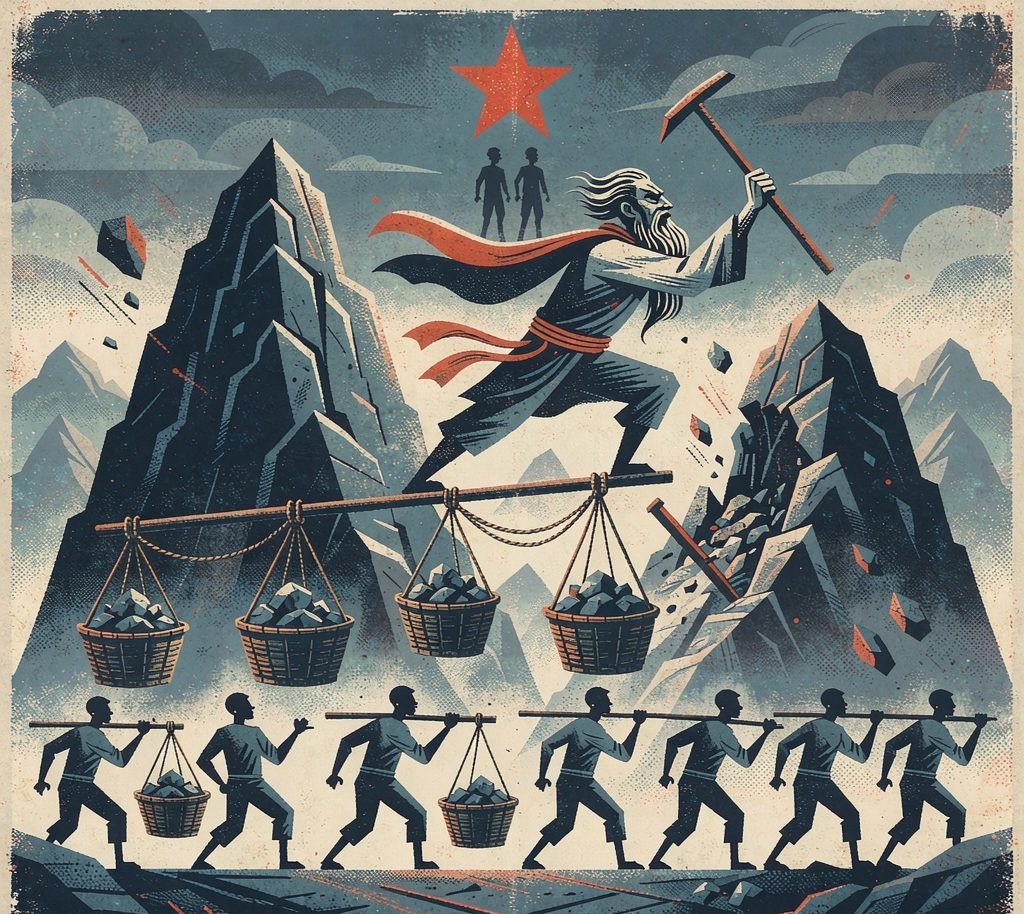
This theme gathers three pieces — 'Serve the People' (1944), 'In Memory of Norman Bethune' (1939) and 'The Foolish Old Man Who Removed the Mountains' (1945) — that are among the most quoted in the collection. Though different in genre, all three exhort a certain spirit: devotion to others, internationalism, and perseverance.
The September 1944 'Serve the People' is the speech at Zhang Side's memorial meeting. It opens with 'our Communist Party and the Eighth Route and New Fourth Armies led by it are one revolutionary team', and treats Zhang Side as 'a comrade in this our team'. It quotes Sima Qian: 'a man dies either heavier than Mount Tai or lighter than a feather', and proposes that to die for the people's interests is heavier than Mount Tai. It also cites Li Dingming's proposal for 'better troops and simpler administration' and says any method good for the people should be adopted and any cadre dispatched.
The December 1939 'In Memory of Norman Bethune' commemorates the Canadian doctor. It says he was sent by the Communist Parties of Canada and the United States to China, and 'felt that the liberation of the Chinese people was his own cause', thereby exemplifying internationalism. It sets out the demands of 'absolute responsibility in work' and 'extreme warmth toward comrades and the people', and says his spirit of utter devotion to others is worthy of learning by every Communist.
The June 1945 'The Foolish Old Man Who Removed the Mountains' retells the Liezi parable: the Foolish Old Man, near ninety, leads his sons to dig away the Taihang and Wangwu mountains; the Wise Old Man mocks him, but the Foolish Old Man says his sons will have sons, and sons' sons without end, while the mountains will not grow, so why worry about not leveling them. The text uses this to say that the Communist Party and the people it leads will 'move' the two mountains of imperialism and feudalism weighing on the Chinese people, 'digging every day'.
Read together, the three share a rhetorical move: each invokes a concrete instance or fable to make a general demand. 'Serve the People' uses Zhang Side's death; 'In Memory of Norman Bethune' uses Bethune's life; 'The Foolish Old Man' uses the parable. All three were speeches or memorial addresses, spoken rather than written as treatises, which is why their tone is close to speech.
Editor's note: this page is read across by theme; excerpts are taken verbatim from the base text. The 'Foolish Old Man' story's source is given in the note on the same page. This page only states what each piece exhorts, offers no evaluation, and draws no analogy to other periods.
Excerpts
Works Cited
War and the Military
5 works · Read the theme page →
This theme gathers five pieces from 12 October 1938 to 25 October 1958. Their genres differ greatly: one is a congress report, one a surrender demand, three are messages issued in the name of the Ministry of National Defence. All five directly handle combat, ceasefire and the arrangement of shelling.
The 12 October 1938 'On the New Stage' is Mao Zedong's report to the enlarged Sixth Plenum. The second part sums up fifteen months of the war, holding: first, the war of resistance is long, not short, so the strategic principle is protracted war, not quick decision; second, China's war of resistance can win final victory, the defeatists having no ground; third, the path to victory lies in uniting and rallying the whole nation, striving to advance and relying on the masses.
The report also compares the theories of quick victory and long war, saying that at the start of the resistance many, not starting from the basic contrast of enemy and our strength but from several transient and superficial phenomena, imagined the war would soon be settled and the idea of quick victory prevailed for a time. The report also discusses forms of fighting, saying in the new stage the main force army holds the front defence while guerrilla war behind the enemy will temporarily become the main form; in certain important strategic areas we will meet the enemy's cruel attacks, large formations will be hard to keep in the plains, and the mountains will become the main base areas.
The December 1948 'Urging Du Yuming and Others to Surrender' is signed by the headquarters of the Central Plains People's Liberation Army, addressed to Generals Du Yuming, Qiu Qingquan and Li Mi and the regimental, battalion and company commanders of the Qiu and Li corps. It first states the battlefield situation, that the Huang Wei corps was utterly wiped out on the evening of the 15th and the Li Yannian corps has turned south; and that your aeroplanes and tanks are of no use either, we have more aeroplanes and tanks than you — these are called 'earthen aeroplanes' and 'earthen tanks', made of artillery and explosives.
It also lists the numbers of losses on both sides, saying you have altogether lost thirty-four divisions, of which, apart from several that mutinied or surrendered, the remaining twenty-seven and a half divisions were all annihilated by this army; and that the ends of the Huang Baitao, Huang Wei and Sun Yuanliang corps you have seen with your own eyes. The end sets the terms: order the whole army to lay down its weapons and stop resisting at once; this army can guarantee the personal safety of your senior commanders and all officers and men; only thus is there your sole way out.
The three 1958 messages are different again. The 6 October 'Message to Compatriots in Taiwan from the Ministry of National Defence', signed by Defence Minister Peng Dehuai, opens with 'we are all Chinese. Of the thirty-six stratagems, alliance is best', and says the Jinmen fighting is of a punitive nature. It announces that, for humanitarian reasons, it has ordered the Fujian front, from 6 October, for a provisional period of seven days, to stop shelling, and you may send supplies freely, provided there is no American escort.
The same message also proposes negotiations, saying the war between you and us has lasted thirty years and is not yet ended, which is not good, and proposes holding talks for a peaceful settlement; it says this is a matter between the two sides, the Kuomintang and the Communists, not between China and the US — the US occupation of Penghu and the Taiwan Strait is the China-US matter. It says Taiwan, Penghu, Jinmen and Mazu are part of China, not another country; in the world there is only one China, not two.
The 13 October 'Order of the Ministry of National Defence' also signed by Peng Dehuai, says the shelling of Jinmen is suspended for another two weeks from this day to observe the enemy's movements and let the military and civilian compatriots of Jinmen be fully supplied, including food and military equipment, to help them hold their ground; it says this is to deal with the Americans, and the Sino-US line must be drawn clearly. The message's end rules that in the Jinmen waters no American escort is permitted; if there is an escort, fire at once.
The 25 October 'Third Message to Compatriots in Taiwan from the Ministry of National Defence' extends the scope of the shelling halt: it rules that on even days no shelling occurs, and shelling is uniformly done on odd days, with some targets perhaps not shelled even on odd days. It says Premier Zhou Enlai proposed holding peace talks with you two years earlier, for a reasonable settlement of the historical dispute between the two parties; and that our peace talks are genuine — once concluded, the civil war can be declared ended and all Chinese unite against the external threat.
Read in sequence, the five pieces show a difference in manner: the 1938 report is analysis and summation, using 'protracted war', 'quick decision', 'guerrilla war'; the 1948 surrender demand lists battle situations and terms; the three 1958 messages alternately arrange the stopping and resumption of shelling and repeatedly state the conditions of escort and negotiation. The three messages, nineteen days apart, were all issued in the name of the Ministry of National Defence.
Editor's note: this page is read across by theme; excerpts are taken verbatim from the base text. Each piece's date follows the base text and common cataloguing. The three 1958 messages were issued in the name of the Ministry of National Defence, signed by Peng Dehuai; this page reproduces them. It only states what each piece writes, and offers no evaluation of these military actions.
Excerpts
Works Cited
State-Building, Institutions and Diplomacy
7 works · Read the theme page →
This theme gathers seven pieces from April 1945 to 14 April 1959, spanning fourteen years. The first two were written before the founding of the PRC and discuss what kind of state to build; the last five were written after, in the genre of proclamation, thank-you letter, order and presidential decree, with signatures and wording belonging to state papers.
The April 1945 'On Coalition Government' is the political report to the Seventh National Congress. The report proposes forming a democratic interim coalition government, saying this is to carry out democratic reform, overcome the present crisis, mobilise and unite the anti-Japanese forces of all China, and fight effectively in co-ordination with the Allied countries; in a word, take the line of unity and democracy, defeat the invaders and build a new China. The report also says it will focus on the coalition-government question.
The report's seventh item discusses industry, saying on the whole there can be no industrial China without an independent, free, democratic and unified China; and that without independence, freedom, democracy and unity there can be no truly large-scale nationwide industry, and without industry no solid national defence, no people's welfare, no national wealth and strength. The report also writes of foreign investment, saying that foreign investment, on condition of obeying Chinese law and benefiting the Chinese economy, is welcome to us.
The April 1945 'The Two Fates of China' is the speech at the congress's opening. It says there are two fates for China, one already written in a book by someone, and our congress represents the other fate, and we too will write a book. It also says that even after Japanese imperialism is defeated, there remain these two futures: a new China or an old China. It lists four conditions it holds achievable: a strong Communist Party, a strong liberated area, the support of the broad masses of the whole country, and the assistance of people all over the world.
The 1 October 1949 'Proclamation of the Central People's Government of the PRC' proclaims the founding of the Central People's Government. The proclamation first reviews the war, saying the war of the people's liberation has basically won, and most of the people of the country have been liberated; then explains that the First Plenary Session of the Chinese People's Political Consultative Conference, composed of representatives of all democratic parties, people's organisations, the People's Liberation Army, various regions, all nationalities, overseas Chinese and other patriotic democratic elements, has met, enacted the organic law of the Central People's Government, and elected Mao Zedong chairman. The proclamation lists the vice-chairmen and members and fixes Beijing as the capital.
The proclamation also records that day's resolutions: accepting the Common Programme of the CPPCC as this government's policy; appointing Zhou Enlai premier of the Government Administration Council and minister of foreign affairs, Mao Zedong chairman of the Revolutionary Military Commission of the People's Revolution, Zhu De commander-in-chief of the People's Liberation Army, and others, charging them to form the various government bodies promptly. It also resolves to announce to all governments that this government is the sole legal government representing the whole people of the PRC, and that it is willing to establish diplomatic relations with any foreign government that observes the principles of equality, mutual benefit and mutual respect for territorial sovereignty.
The two 1954 thank-you letters are both to the Soviet government delegation. 'Letter of Thanks... (Machine Tools and Agricultural Machines)' records that the Soviet government will present to China, as gifts, the eighty-three exhibits — machine tools and agricultural machines — of the Soviet economic and cultural achievements exhibition to be held in Beijing; the text says the Chinese people will regard this generous gift as a concrete expression of the Soviet people's friendly sentiment toward the Chinese people.
The 'Letter of Thanks... (State Grain Farm)' records that the Soviet government delegation, on behalf of the Soviet people, presents to the Chinese people the machinery and equipment necessary to organise a state grain farm of twenty thousand hectares of sown area, and prepares to send a group of experts to the PRC as advisers. It says this state grain farm will not only play an important exemplary role in promoting the socialist transformation of China's agriculture, but will also help China train technical personnel in agricultural production and learn the Soviet experience of reclaiming virgin and cultivated wasteland. The base text also attaches a twelve-item exhibit list.
The 1955 'Order Ending the State of War Between the PRC and Germany' first explains that China declared a state of war with Germany on 9 December 1941, and then says the US, Britain and France are actively scheming, through the Paris Agreements, further to obstruct the peaceful unification of Germany and the conclusion of a peace treaty with Germany. It announces two points: the state of war between the PRC and Germany is ended from now on, and peaceful relations between the two countries should be established; the ending of the state of war does not alter Germany's international obligations, nor affect the rights China enjoys and the obligations it bears under international agreements concerning Germany.
The 14 April 1959 'Presidential Decree of the PRC' is only a few sentences, promulgating the organic regulations of the People's Congress and People's Committee of Tongdao Dong Autonomous County, Hunan, already approved by the 108th session of the Standing Committee of the First National People's Congress on 14 April 1959, now promulgated. It is the only document in this theme concerning local autonomy, and the shortest.
Editor's note: this page is read across by theme; excerpts are taken verbatim from the base text. Each piece's date follows the base text and common cataloguing. The two 1954 thank-you letters and the 1955 order are state papers; the base text gives the signing identity as Chairman of the PRC or Chairman of the Central People's Government; this page reproduces them, offering no evaluation.