State-Building, Institutions and Diplomacy
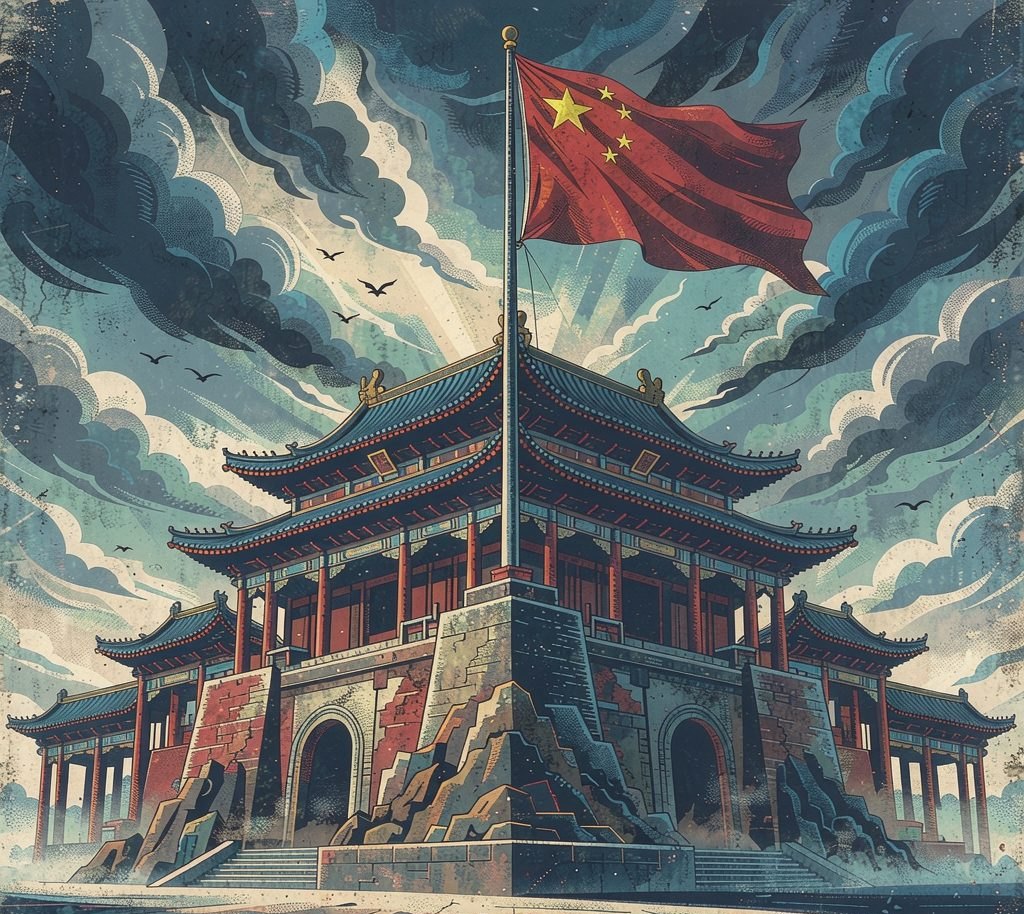
This theme gathers seven pieces from April 1945 to 14 April 1959, spanning fourteen years. The first two were written before the founding of the PRC and discuss what kind of state to build; the last five were written after, in the genre of proclamation, thank-you letter, order and presidential decree, with signatures and wording belonging to state papers.
The April 1945 'On Coalition Government' is the political report to the Seventh National Congress. The report proposes forming a democratic interim coalition government, saying this is to carry out democratic reform, overcome the present crisis, mobilise and unite the anti-Japanese forces of all China, and fight effectively in co-ordination with the Allied countries; in a word, take the line of unity and democracy, defeat the invaders and build a new China. The report also says it will focus on the coalition-government question.
The report's seventh item discusses industry, saying on the whole there can be no industrial China without an independent, free, democratic and unified China; and that without independence, freedom, democracy and unity there can be no truly large-scale nationwide industry, and without industry no solid national defence, no people's welfare, no national wealth and strength. The report also writes of foreign investment, saying that foreign investment, on condition of obeying Chinese law and benefiting the Chinese economy, is welcome to us.
The April 1945 'The Two Fates of China' is the speech at the congress's opening. It says there are two fates for China, one already written in a book by someone, and our congress represents the other fate, and we too will write a book. It also says that even after Japanese imperialism is defeated, there remain these two futures: a new China or an old China. It lists four conditions it holds achievable: a strong Communist Party, a strong liberated area, the support of the broad masses of the whole country, and the assistance of people all over the world.
The 1 October 1949 'Proclamation of the Central People's Government of the PRC' proclaims the founding of the Central People's Government. The proclamation first reviews the war, saying the war of the people's liberation has basically won, and most of the people of the country have been liberated; then explains that the First Plenary Session of the Chinese People's Political Consultative Conference, composed of representatives of all democratic parties, people's organisations, the People's Liberation Army, various regions, all nationalities, overseas Chinese and other patriotic democratic elements, has met, enacted the organic law of the Central People's Government, and elected Mao Zedong chairman. The proclamation lists the vice-chairmen and members and fixes Beijing as the capital.
The proclamation also records that day's resolutions: accepting the Common Programme of the CPPCC as this government's policy; appointing Zhou Enlai premier of the Government Administration Council and minister of foreign affairs, Mao Zedong chairman of the Revolutionary Military Commission of the People's Revolution, Zhu De commander-in-chief of the People's Liberation Army, and others, charging them to form the various government bodies promptly. It also resolves to announce to all governments that this government is the sole legal government representing the whole people of the PRC, and that it is willing to establish diplomatic relations with any foreign government that observes the principles of equality, mutual benefit and mutual respect for territorial sovereignty.
The two 1954 thank-you letters are both to the Soviet government delegation. 'Letter of Thanks... (Machine Tools and Agricultural Machines)' records that the Soviet government will present to China, as gifts, the eighty-three exhibits — machine tools and agricultural machines — of the Soviet economic and cultural achievements exhibition to be held in Beijing; the text says the Chinese people will regard this generous gift as a concrete expression of the Soviet people's friendly sentiment toward the Chinese people.
The 'Letter of Thanks... (State Grain Farm)' records that the Soviet government delegation, on behalf of the Soviet people, presents to the Chinese people the machinery and equipment necessary to organise a state grain farm of twenty thousand hectares of sown area, and prepares to send a group of experts to the PRC as advisers. It says this state grain farm will not only play an important exemplary role in promoting the socialist transformation of China's agriculture, but will also help China train technical personnel in agricultural production and learn the Soviet experience of reclaiming virgin and cultivated wasteland. The base text also attaches a twelve-item exhibit list.
The 1955 'Order Ending the State of War Between the PRC and Germany' first explains that China declared a state of war with Germany on 9 December 1941, and then says the US, Britain and France are actively scheming, through the Paris Agreements, further to obstruct the peaceful unification of Germany and the conclusion of a peace treaty with Germany. It announces two points: the state of war between the PRC and Germany is ended from now on, and peaceful relations between the two countries should be established; the ending of the state of war does not alter Germany's international obligations, nor affect the rights China enjoys and the obligations it bears under international agreements concerning Germany.
The 14 April 1959 'Presidential Decree of the PRC' is only a few sentences, promulgating the organic regulations of the People's Congress and People's Committee of Tongdao Dong Autonomous County, Hunan, already approved by the 108th session of the Standing Committee of the First National People's Congress on 14 April 1959, now promulgated. It is the only document in this theme concerning local autonomy, and the shortest.
Editor's note: this page is read across by theme; excerpts are taken verbatim from the base text. Each piece's date follows the base text and common cataloguing. The two 1954 thank-you letters and the 1955 order are state papers; the base text gives the signing identity as Chairman of the PRC or Chairman of the Central People's Government; this page reproduces them, offering no evaluation.