Serving the People and Moral Examples
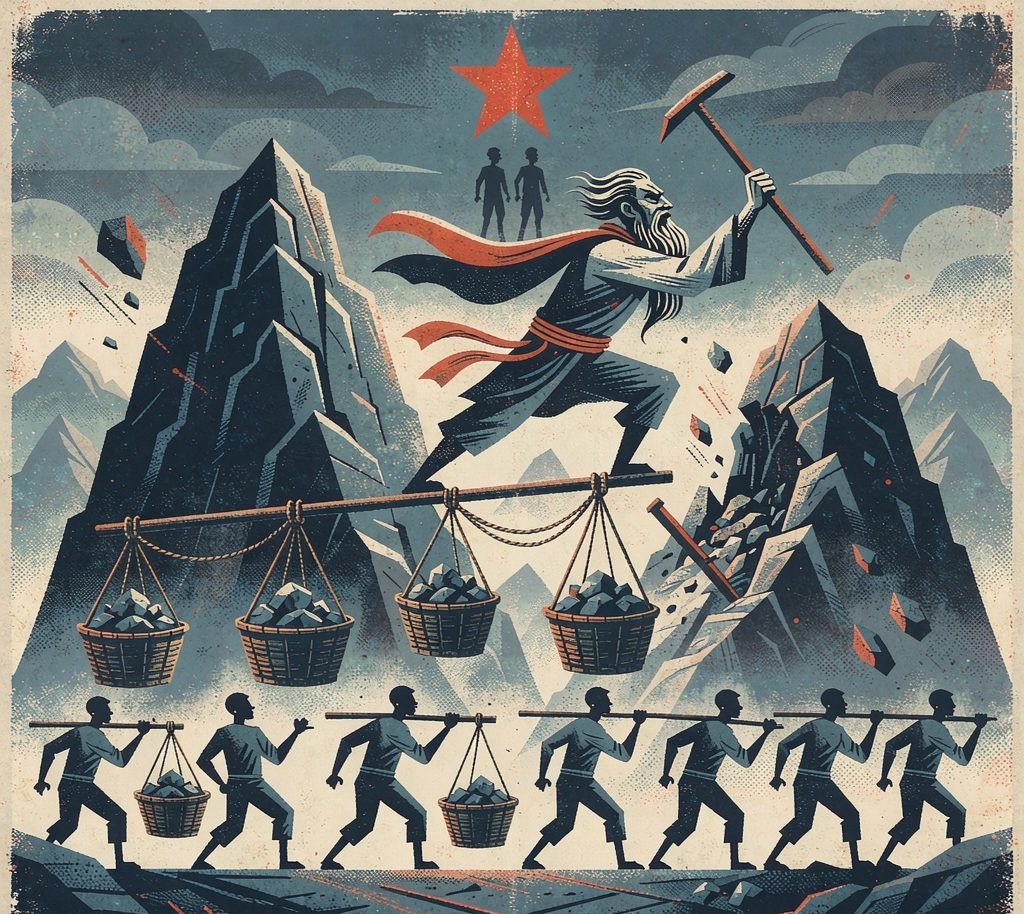
This theme gathers three pieces — 'Serve the People' (1944), 'In Memory of Norman Bethune' (1939) and 'The Foolish Old Man Who Removed the Mountains' (1945) — that are among the most quoted in the collection. Though different in genre, all three exhort a certain spirit: devotion to others, internationalism, and perseverance.
The September 1944 'Serve the People' is the speech at Zhang Side's memorial meeting. It opens with 'our Communist Party and the Eighth Route and New Fourth Armies led by it are one revolutionary team', and treats Zhang Side as 'a comrade in this our team'. It quotes Sima Qian: 'a man dies either heavier than Mount Tai or lighter than a feather', and proposes that to die for the people's interests is heavier than Mount Tai. It also cites Li Dingming's proposal for 'better troops and simpler administration' and says any method good for the people should be adopted and any cadre dispatched.
The December 1939 'In Memory of Norman Bethune' commemorates the Canadian doctor. It says he was sent by the Communist Parties of Canada and the United States to China, and 'felt that the liberation of the Chinese people was his own cause', thereby exemplifying internationalism. It sets out the demands of 'absolute responsibility in work' and 'extreme warmth toward comrades and the people', and says his spirit of utter devotion to others is worthy of learning by every Communist.
The June 1945 'The Foolish Old Man Who Removed the Mountains' retells the Liezi parable: the Foolish Old Man, near ninety, leads his sons to dig away the Taihang and Wangwu mountains; the Wise Old Man mocks him, but the Foolish Old Man says his sons will have sons, and sons' sons without end, while the mountains will not grow, so why worry about not leveling them. The text uses this to say that the Communist Party and the people it leads will 'move' the two mountains of imperialism and feudalism weighing on the Chinese people, 'digging every day'.
Read together, the three share a rhetorical move: each invokes a concrete instance or fable to make a general demand. 'Serve the People' uses Zhang Side's death; 'In Memory of Norman Bethune' uses Bethune's life; 'The Foolish Old Man' uses the parable. All three were speeches or memorial addresses, spoken rather than written as treatises, which is why their tone is close to speech.
Editor's note: this page is read across by theme; excerpts are taken verbatim from the base text. The 'Foolish Old Man' story's source is given in the note on the same page. This page only states what each piece exhorts, offers no evaluation, and draws no analogy to other periods.