The United Front and Resistance
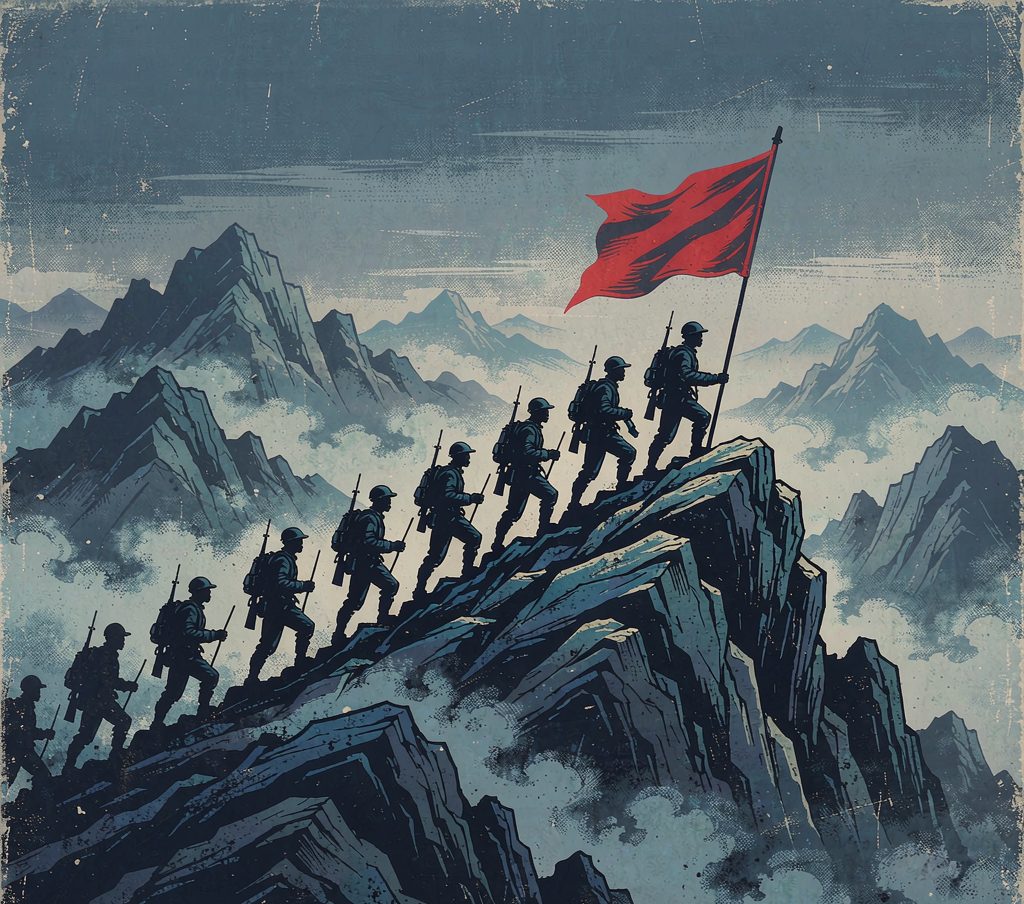
This theme gathers five pieces written between December 1935 and 24 April 1945. The first three are declarations and telegrams addressed to the military and political organs of the whole country, the parties and groups, and compatriots who will not be slaves; the last two are congress reports. All five speak of union: whom to unite with, what to unite for, in what form, and what government to form after uniting.
The December 1935 'Declaration of the Central Soviet Government to the People of Inner Mongolia' makes the object of union concrete: only by struggling together with the Inner Mongolian nation can we quickly defeat our common enemy, Japanese imperialism and Chiang Kai-shek; and the Inner Mongolian nation may organise itself as it wishes, has the right to organise its life on the principle of autonomy, to form a federal relation with other nations, or to separate completely. The declaration's end says that whoever has the resolve against Japanese imperialism and Chiang Kai-shek and the other Chinese warlords, whether led by princes and nobles or by commoners, may be given well-meaning and substantial assistance.
The 1936 'Declaration Against the Obstruction...' is signed by Mao Zedong, chairman of the Central Soviet Government of the Chinese Soviet Republic, and Zhu De, chairman of the Revolutionary Military Commission of the Chinese Anti-Japanese Red Army. It says that at the critical juncture of national subjugation, the Soviet government and the Revolutionary Military Commission have repeatedly demanded an end to all civil war, a united resistance regardless of Red or White army, the convening of a national anti-Japanese congress to form a national-defence government and allied anti-Japanese armies, and the concentration of the nation's main Red Army in Hebei. It also opposes the Sino-'Manchukuo' joint 'anti-Communist' pact and calls for allying with Russia and the Communists to resist Japan and win China's independence and freedom.
The May 1936 'Telegram on Ceasing Fire...' goes to the Nanjing National Government, the Military Commission, all land-sea-air forces, all parties and groups, all newspapers and all compatriots unwilling to be slaves. It says the Chinese People's Anti-Japanese Vanguard Army had intended to concentrate its full strength to destroy the troops blocking its path against Chiang, but the Soviet Central Government and the Red Army Revolutionary Military Commission, considering that at this national crisis a decisive battle between the two sides, whoever wins, is a loss to China's national defence and a delight to Japanese imperialism, decided otherwise.
The same telegram announces that, though many victories were won in Shanxi, the People's Anti-Japanese Vanguard Army is withdrawn to the west bank of the Yellow River, as a token of sincerity, willing to cease fire and make peace with all armed forces attacking the Red Army within one month, to reach the goal of united resistance. It also advises the Nanjing authorities that at this critical juncture of national subjugation they should repent and change course, first stop the civil war in Shaanxi-Gansu-Shanxi, and send representatives from both sides to negotiate the concrete methods of resisting Japan and saving the nation; it calls on all groups, people and parties unwilling to be slaves to organise a society to promote the stopping of the civil war.
The 12 October 1938 'On the New Stage' is Mao Zedong's report to the enlarged Sixth Plenum. Summing up fifteen months of the war, it holds three main points: first, the war of resistance is long, not short, so the strategic principle is protracted war, not quick decision; second, China's war of resistance can win final victory; third, the sole correct path to sustaining the long war and winning final victory lies in uniting and rallying the whole nation, striving to advance and relying on the masses. The report's third part is titled 'The New Stage in the Development of the War of Resistance and the Anti-Japanese National United Front'.
The same report also writes of the conditions and difficulties of maintaining union. It says that, thanks to the change of policy of both the Kuomintang and the Communist Party, thanks to the leadership of Chairman Chiang Kai-shek, thanks to the support of the whole people and to the co-operation of other groups and other parties, the Japanese imperialist steps of subjugating all China met an unprecedented national resistance. The report also writes that the crisis of compromise is grave, and that after the unity and effort of the Party and all patriotic-minded people, overcoming the compromise crisis and sustaining the war is absolutely necessary and entirely possible.
The 24 April 1945 'On Coalition Government' writes the idea of union as a form of government. The report says China urgently needs to unite representatives of all parties and groups and of non-party figures to form a democratic interim coalition government, so as to carry out democratic reform, overcome the present crisis, mobilise and unite the anti-Japanese forces of all China, and fight effectively in co-ordination with the Allied countries. It also says whether China should form a democratic coalition government has become a question of great concern to the Chinese people and to Allied public opinion, so the report will focus on the coalition-government question.
Read in sequence, the five pieces show a shift in wording: 1935 and 1936 speak of stopping the civil war, uniting against Japan, forming a national-defence government and allied anti-Japanese armies; 1938 speaks of uniting and rallying the whole nation and long-term co-operation; 1945 speaks of forming a democratic coalition government. The objects addressed expand from the Inner Mongolian people and the patriotic compatriots of the whole country to representatives of all parties and groups and non-party figures.
Editor's note: this page is read across by theme; all excerpts are taken verbatim from the base text. Each piece's date follows the base text and common cataloguing. The forms of address for the various figures and parties are the language of the documents of the time; this page reproduces them, offers no evaluation, and draws no analogy to other periods.